

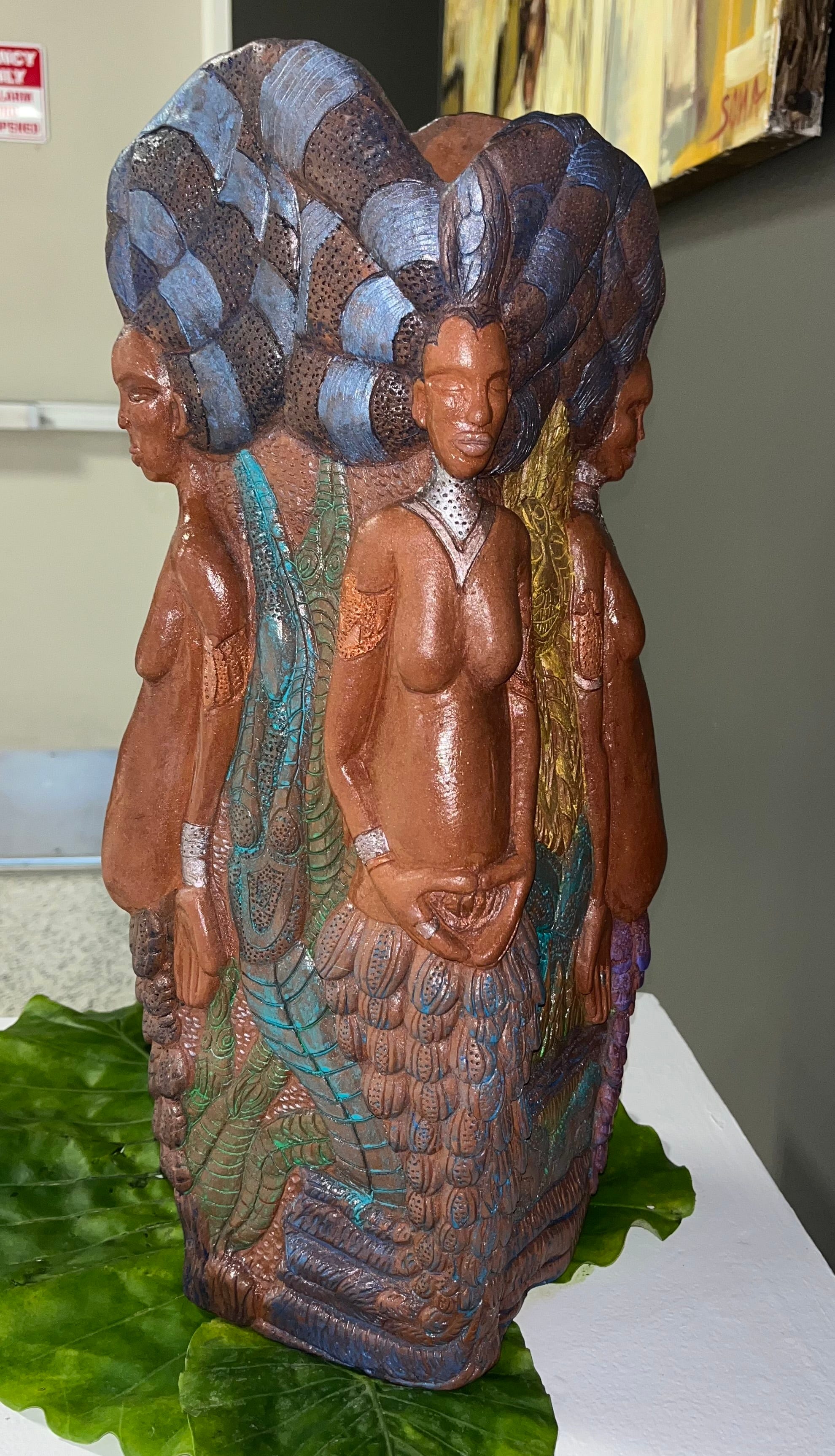
Black Clay, an exhibition featured at ARTE NOIR Gallery in February, reclaimed ceramic practice as an ontological intervention, restoring clay from a purely utilitarian object to a vessel of lifeforce, memory, and cosmological agency. Featuring pottery works from 25 Black ceramics artists, this exhibition situated contemporary ceramic practice within a deep lineage of African and African Diasporic worldviews that have understood clay as animated, relational, and historically charged.
The first impression of the exhibition was that of an archeological dig site—a place where cultural artifacts of previously hidden cosmologies had recently been unearthed. But unlike archeology as it had been practiced in the 18th and 19th centuries, this archeology centers the cultural originators as both authors and interpreters of meaning.
The exhibition space was airy but substantively full, inviting the viewer into a nonlinear experience where works could be viewed from multiple angles—alone and in relation to others. And it’s in this relationality that Black Clay did much of its heavy lifting. Most of the works in the exhibition were gathered in groups. There were the vessels—including the works Freedom Song by Deshun Peoples, Scorched Strands of a Past Life by Tay Baker, and Enslaved Trades People by Esther Ervin—that if viewed out of relational context might be miscategorized as purely functional, decorative, or narrating a bygone era; but together they create a more complex, layered, and nuanced meaning. Enslaved Trades People is a large, raw umber clay pot with a ring of disembodied dark hands linked together by a golden chain and hovering above the unmistakable iconography of plantation labor—a saw and hammer, an anvil and tongs, an iron, and finally a clay vessel. The disembodied hands make visible the instrumentalization of Black humanity to mere utility.
It makes sense that Enslaved Trades People sat atop the tallest pillar in the grouping, representing a temporal rupture that reordered both Black life and material culture under the logic of utility. But Freedom Song refused to forget what was before, its round, spherical form partially references ceremonial water jars commonly used in West Africa. In some cultures, such as the Yoruba, these water jars were not just inert objects but played a crucial role in maintaining spiritual equilibrium. For the Nupe, these clay vessels were both practical and relational representations of community care. Today, Freedom Song can serve as a reminder that our understanding of humanity and the materials humans create was not always rooted in utility.
In Scorched Strands of a Past Life by Tay Baker, this raku fired vessel integrated the artist’s old dreadlocks into the body of the pot, creating a black swirl of color against pale clay. The process, the artist said, allowed him to rid himself of a troubled past while never forgetting the lessons learned. But this work could also represent how Black life has continued to press forward, integrating and metabolizing trauma, memory, lineage, culture, and triumph.
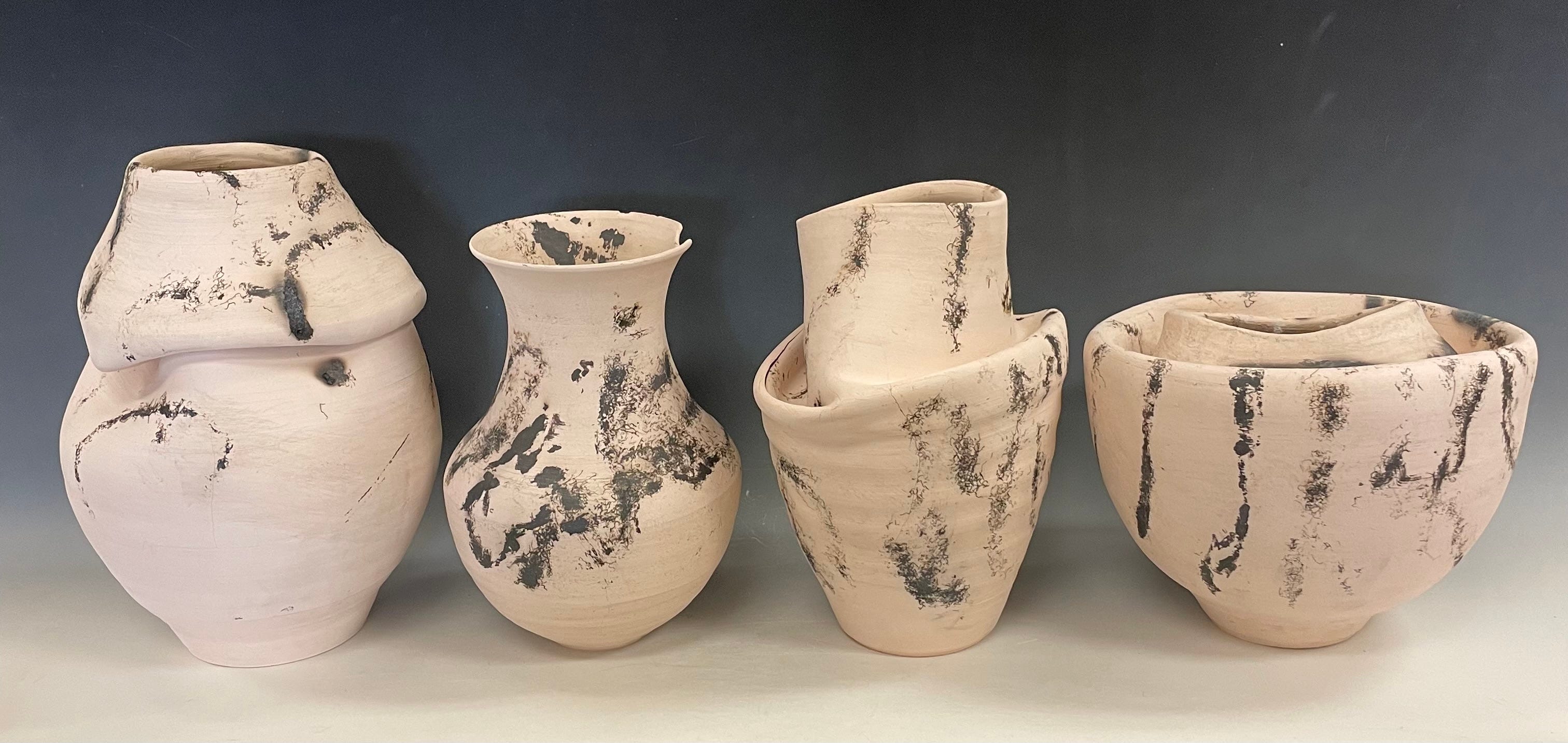
In many African cultures, such as the Kongo, Dogon, and Fon, objects were not inert but contained vital force or energy that could be activated by humans through intentional care, handling, and placement. In the Black Clay exhibition, the grouping of female ceramic figures—including the works KeepHer of the 4 Directions by Rhonda Brown, and the three works Serenity, A Love Letter to Myself, and Mother Nature by Ieisha Sweatmon—could be a continuation of that cosmology. In KeepHer of the 4 Directions, four female aquatic figures emerge from the clay, their voluminous hair connecting them at the crown. Each faces away from the other—East, West, North, South. They are all “Dawtas of Yemaya,” according to the artist, “honoring how the Divine Feminine is sacred, divine, needed, respected, and essential.” Yemaya, also known as Yemọja in Yoruba, is similar to another water entity in diasporic cosmologies, Mami Wata—often associated with wealth, transformation, and protection. And in the context of this exhibition, the four aquatic figures in KeepHer of the 4 Directions could be seen as symbolic agents of protection, transformation, and repair. Protection from the consequences of identity and roles projected onto Black women as depicted in Sweatmon’s A Love Letter to Myself and the much-needed repair as expressed in Serenity. In A Love Letter to Myself, a Black woman rested her head in the cradle of her own arm, her eyes closed, the rest of her body absent. Sweatmon said this ceramic sculpture represents how Black women often pour their energy and care into others but leave themselves feeling incomplete. For the artist, the sculpture is a reminder to “pour into ourselves as we pour into others.” The ceramic figure in Serenity—a carefree Black woman, purple afro, summer dress, resting on a garden of flowers—could be seen as representing the repair, an unapologetic commitment to self-care. And the “Dawtas of Yemaya” look on.
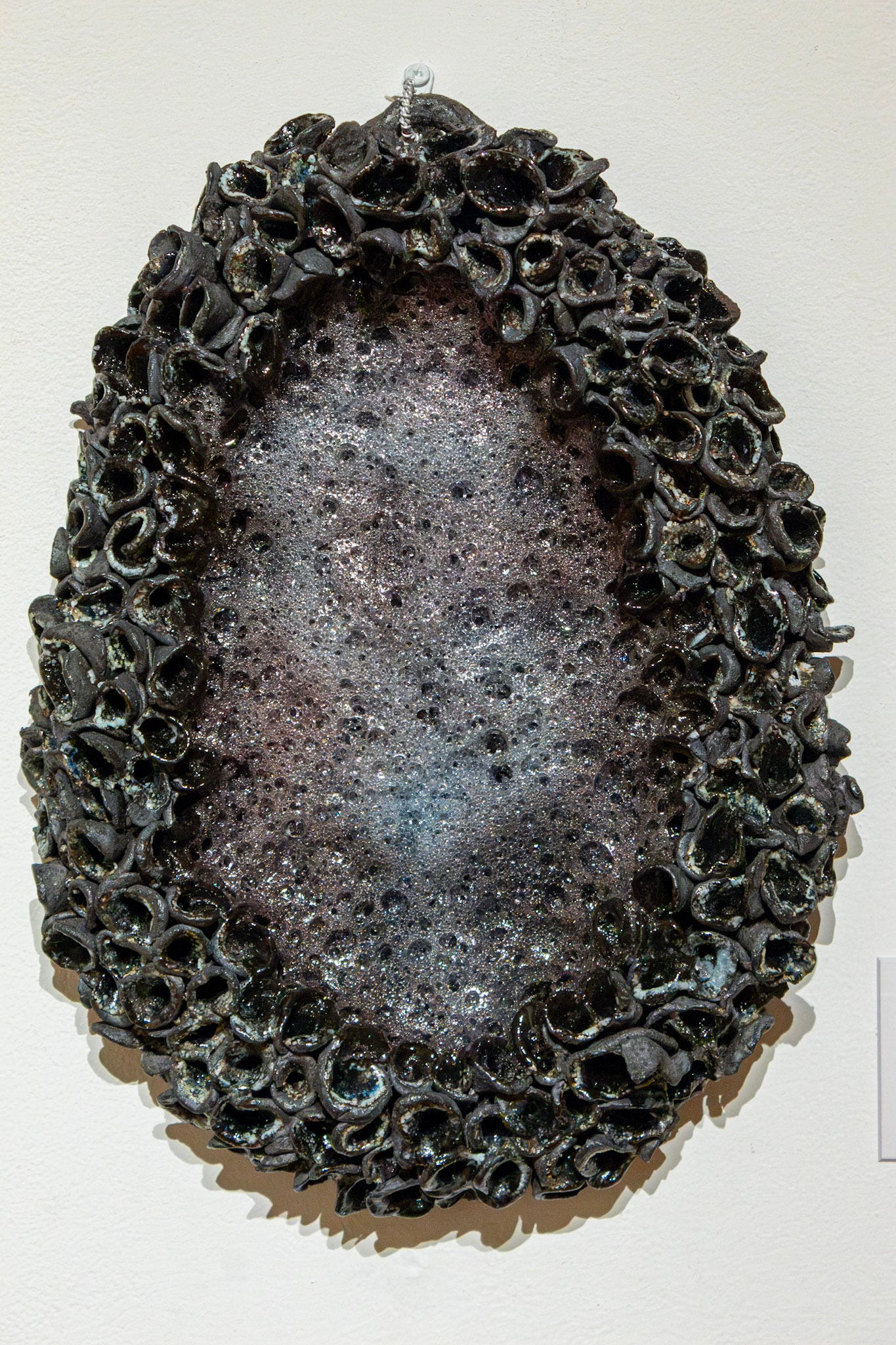
Hung on a wall of the exhibition is Mirror, Mirror by Myia Crawford, an oval clay and marble structure with a center that’s light, airy, and foamy, like the crest of a crashing wave or an undisturbed bubble bath. Directly across from Mirror, Mirror were three ceramic animal heads shaped into mystical and surrealistic forms: The red-beaked bird with a serpent-like tongue (Shadow Work by Sienna Bundy); the two-headed, horned creature merged and emotive (Cousin Sandstorm by Sienna Bundy); and the mythical deer head, (Guide #2 by Sienna Bundy), its mouth agape, its teeth bared. This is another realm, and Mirror, Mirror is the portal. We have crossed the Kalûnga line, and the water has taken us there. The “Dawtas of Yemaya” watch the four corners of the Earth; their spirits connected to both the land of the living and the realm of the ancestors. They are watching the enslaved people labor, instrumentalized. They are present in the water of life that nurtures the descendants—mother’s milk, hinted at but not seen in Tits by Vina Nweke, three large earthy-toned breasts linked together by a beaded necklace. They are watching the descendants walk the bloody path of “resistance, freedom, and emotional healing” as explored in Angel Ohome’s Blood-Stained Paths—tiny, slightly concaved ceramic tiles, white, green, blue, and various shades of red, linked together by twisted wire. The descendants have awakened, and through the water they shape Black Clay.
The group exhibition Black Clay, which closed in February, featured works from the following artists: Sasa Akil, Imani Anderson, Kouassi Aragao-Romero, Michaela Ayers, Tay Baker-Johnson, Del Bey, Ronda Brown, Sierra Bundy, Japera Burres, Lea Cook, Myia Crawford, Esther Ervin, Sally Gibson, Joanna Henry, Shirley Jackson, Bianca McPherson, Vina Nweke, Angel Ohome, Deshun Peoples, Perri Rhoden, Tammie Rubin, Darius Scott, Veronica Smith, Ieisha Sweatmon, and Willow Vergara-Agyakwa.