

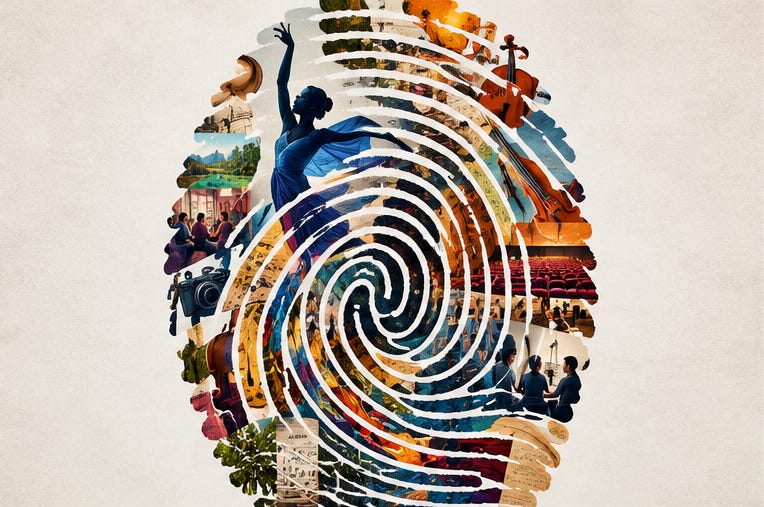
Identity is the story you tell yourself about who you are. It’s not simply what you do, the role you play, or the services your organization provides. It’s the deeper understanding of who you believe yourself—or your organization—to be.
And that understanding isn’t fixed. It can evolve as you grow, as your work changes, and as you discover dimensions of yourself you hadn’t fully recognized. But whether your identity is accurate, outdated, or incomplete, it informs the actions you take, what you avoid, what you believe is possible, and even the opportunities you pursue.
This is true whether you’re an individual artist or the leader of a nonprofit or social-good organization. Identity is the head that moves the body.
So here’s a question worth asking: Is the story you’re telling yourself helping you move forward, or is it the very thing holding you back?
Identity Can Limit You
In my work as a narrative architect, I worked with a nonprofit client that was well known and respected in their community. But despite having a strong existing community, they wanted to expand their audiences and funding sources. They were located in the United States but operated globally. They saw themselves primarily as a teaching organization that taught a culturally specific art form to people within and outside of their cultural community. Their identity as teachers influenced how they described their work and whom they approached to support it. When they approached funders, they emphasized the number of community members they taught and how many instructors they trained. There was nothing inherently wrong with that approach. However, their identity as ‘teacher’ represented only a small fraction of who they were.
Identity Can Evolve
When this particular nonprofit first started many years ago, they were teaching a small group of people, but their work quickly expanded and they eventually began to train other instructors to start their own teaching practices. At the time, their identity as teachers accurately reflected who they were. But eventually the work they did included so much more. They began sharing their culturally specific art form with audiences around the world and even began to help others understand the deeper meanings behind the work through writings and audio/video recordings. This expansion happened over the course of more than a decade. However, they continued to think of themselves as only a teaching organization. It was true that their identity as ‘teacher’ was accurate but that identity wasn’t complete. When we got deeper into our work together, we uncovered something else: They weren’t just teaching—they were keeping a specific art form alive and spreading the knowledge and awareness of that art form globally. And those two activities helped the client understand that while their organization was rooted in teaching, it was also rooted in “cultural preservation” and “cultural transmission.” It’s important for us to pause for a moment and recognize that teaching, cultural preservation, and cultural transmission are all activities, and an activity may be informed by identity but is NOT identity. Identity goes deeper. Identity is that story that the organization tells itself about who it is. In this case, the activity was teaching, and the organization’s identity was “we are teachers.” But the founder’s understanding of the organization’s identity eventually evolved. They came to see the organization as ‘cultural infrastructure’ that bridged the gap between the people within their cultural group and those outside of it, provided a safe space for their students and audiences to learn, and preserved an important cultural practice.
What’s Your Identity?
To begin understanding your own identity, complete the following exercises:
1. List 3 things you did in the past 5 to 10 years that are deeply meaningful to you.
If you’re an organization, you might want to focus on your organization’s impact. If you’re an individual artist, you might want to focus on the evolution of your craft.
Example 1: Maybe your organization is a youth arts camp and you arranged a career day for your teens, increased the number of youths served by 50%, and arranged an exhibition for the youth at a local art gallery.
Example 2: If you’re an individual artist, maybe you improved some aspect of your craft, experimented with some risky topic or technique, and increased your productive output or the quality of that output.
2. Looking at the three things you listed that were meaningful, I want you to write about why they were meaningful to you.
This is where we dive into the unique DNA of your identity. Two organizations might be equally proud of arranging an exhibition for young artists, but for very different reasons.
Example 1: Organization A arranged an exhibition for the youth at a local art gallery but it is a meaningful accomplishment because they are dedicated to introducing youth to gallery owners and creating opportunities to network in the art world. On the other hand, Organization B is proud of their youth exhibition at the gallery because they want to expose the community to the art of youth with autism. Same accomplishment, but different meanings behind it.
Example 2: Visual Artist A is proud of their transition into abstract art because they have long admired several abstract artists and finally overcame their fear of transitioning from a figurative art practice to abstraction. Visual Artist B is also proud of their transition to an abstract art practice, but for a different reason: it opens doors to exhibiting at several respected galleries that specialize in abstraction. Both artists made the same transition in their practice, but that transition was meaningful to them for very different reasons.
3. What do your answers to these questions suggest about your identity?
Before you answer, it’s important to understand that identity is complex and cannot be assessed with just three exercises. They are designed to serve as starting points. So, let’s take a closer look at some of our examples.
In the case of Organization A, arranging a youth exhibition at a gallery is important because they are dedicated to introducing youth to gallery owners and creating opportunities to network in the art world. But that same accomplishment could suggest a wide range of possible identities:
A. They are champions of underserved youth.
B. They are changemakers in the commercial art world.
C. They are cultural stewards for a specific neighborhood.
D. Anything else not listed here.
You see, you can have 10 organizations doing the same things for the same reasons even as their underlying identity is completely different. And most importantly, once they recognize the unique DNA of their identity, they will have the raw material needed to engage in their organizational activities in a way that reflects their unique identity. That’s differentiation.
Let’s take a look at one of our individual artists.
In the case of Visual Artist B, they are proud of their transition to an abstract art practice because it opens the doors to exhibiting at several respected galleries that specialize in abstract art. What this may suggest about their identity:
A. They are an ambitious career builder.
B. They are an outsider seeking belonging.
C. They are a cultural representative.
D. Anything else not listed here.
Once again, the same decision, made for the same reason, can reflect very different identities. What do your answers suggest about your identity?
In my work as a narrative architect, I take clients through an extensive process to uncover the unique DNA of their identity. The goal isn’t simply to find better words to describe what they do. It’s to give them a foundation for making decisions about how they work, how they approach their organizational activities, and how they communicate with audiences, communities, stakeholders, and funders. Instead of chasing the latest TikTok trend or copying what everyone else is doing, they can draw on something much more meaningful: their own understanding of who they are. That’s where authentic differentiation begins.
Ready to explore your organization’s identity?
Learn how Narrative Architecture can help your organization uncover its unique identity and use it to inform strategy, operations, and communications. CLICK HERE.
© Copyright 2026 - Artists Up Close/Beverly Aarons. All rights reserved.