

This article is available in Spanish, French, Arabic, Swahili, and Chinese. All translations were made using a computer so there may be some small errors.
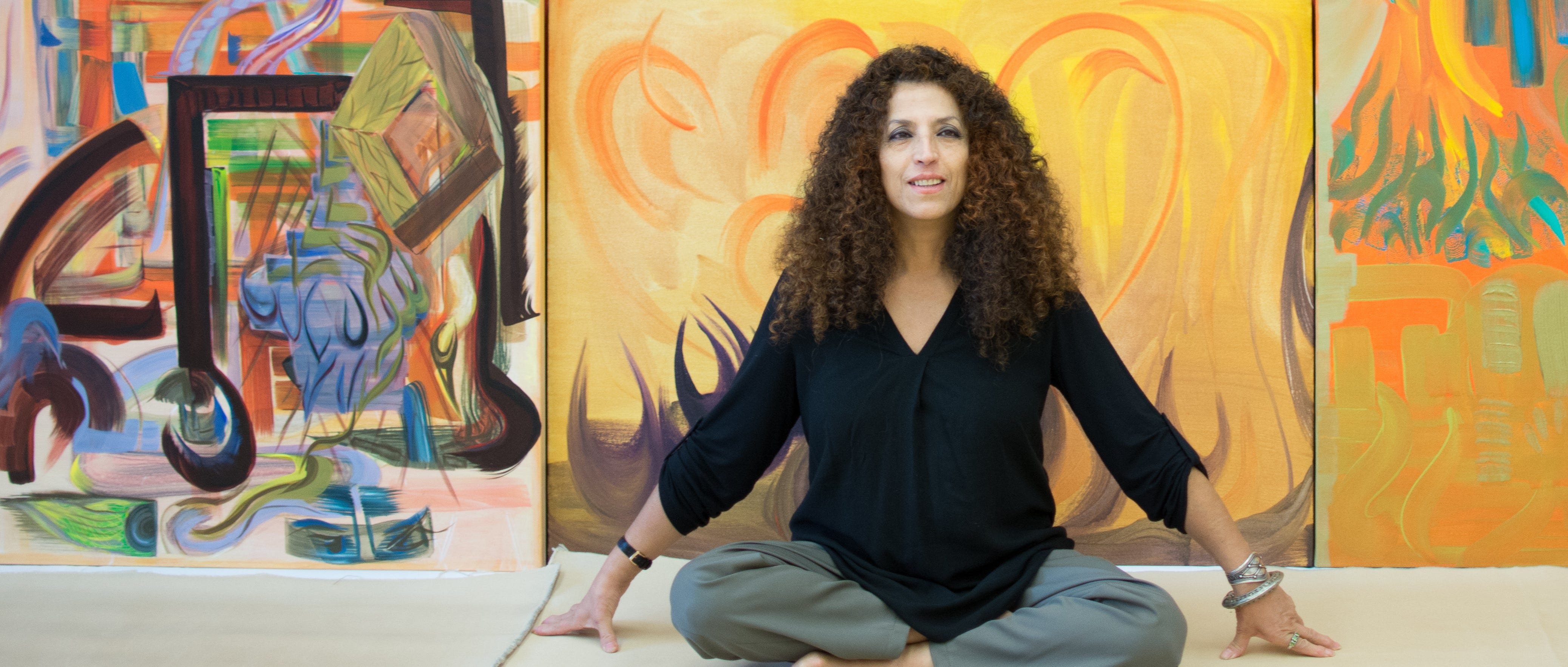
Unfolding like a cosmic nesting doll, Rajaa Gharbi’s creative life is filled with a constellation of surprising layers. She’s a painter and a poet who merges lettering and imagery. She’s a filmmaker, puppeteer, and sociolinguist who explores how the languages we speak impact how we live, think, and imagine. She was born in Tunisia in the 1950s, during a time of political change, economic hardship, and the expansion of women’s rights. Now, in Seattle for the past 30+ years, Gharbi doesn’t seem to be slowing down. Over the course of three interviews, Rajaa Gharbi shared her life and creative journey with Artists Up Close.
“The evolution of languages, that informs my curiosity,” Gharbi said. “That is my vehicle, if you will. It is the car I drive to explore. That's really my road trip: How I get to understand or find out, even the minute detail, about how we started talking.”
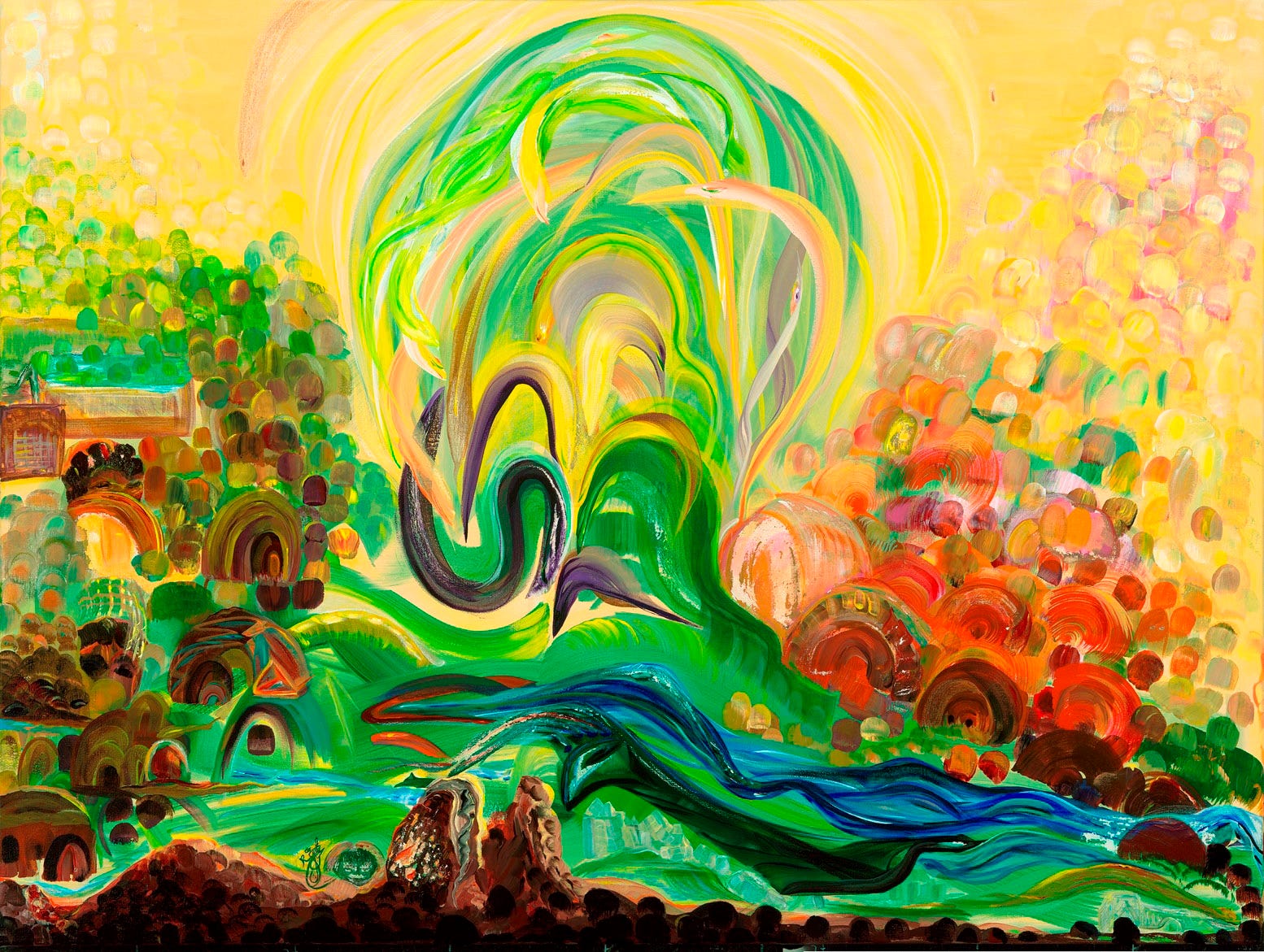
Gharbi speaks Arabic, French, English, and some Spanish but her paintings incorporate scripts from all over the world including Tifinagh, which she said is, according research so far, the oldest alphabet in Africa. Tifinagh inscriptions can be found on difficult to access mountains in Africa and has been dated to be at least 10,000 years old. And it’s this ancientness that Gharbi uses to revisit the “origins of things” in her artwork. She transforms the letters in such a way that in her final artwork it can be difficult for the viewer to recognize them as letters without some effort on their part. And it’s through this effort that Gharbi hopes the viewer will understand that we are all connected through written language. She offered an example of how the letter ‘A’ in the English alphabet may actually have its origins in Tifinagh, and looks like a ram's head in the Nabatean alphabet.


“You take the letter ‘A’ reverse it, put it upside down,” Rajaa Gharbi said. “So uppercase A, you turn it upside down and the two bars on the sides you round them up a little bit. Write them cursively a little bit. … You will see that it is actually the horns of the ram. Now, let's go back to ancient Egypt. And let's go back to the Tifinagh alphabet, which is again, the African alphabet that I was talking about that is very old, older than the hieroglyphs of Egypt. You'll see that it's actually the symbol of the ram. Now you go back to the history, the spiritual history of Egypt. … You will see that Baal, the god Baal, that there is a specific meaning attached to the ram. Okay? That's one letter. So, if we look at a lot of the alphabets in the world, lots of them have borrowed or evolved letters from a much older alphabet during certain migrations.”
Long before her own migration from Tunisia to Morrocco and eventually the United States, Rajaa Gharbi’s curiosity about language, culture and art was nurtured by her family’s deep artistic roots. Gharbi’s paternal grandmother was the personal storyteller of the last Tunisian King, Sidi Moncef Bey and his family. And Gharbi’s mother, and one of her brothers, grew up in the royal palace after the King’s niece adopted them when their mother died of pneumonia. And it was the palace's creative milieu that nurtured Gharbi's parents and sustained them in the lean years following Tunisian independence.
“So, my mother grew up with artistic influences, cultural influences, and everything of the palace, which is now the house of parliament in Tunisia,” Rajaa said, also explaining that her mother’s family had indigenous Berber roots. “And they went from that position when the King [Sidi Moncef Bey] was killed by France, basically. So, he became a martyr, for militants, for liberation, for independence from France. And everybody who was aristocratic by blood or by profession, like my grandmother, was demoted. Everything went to the people when we became a republic. And everything changed. … To this day, I'm really trying to fathom it — from having been brought up in the wealth of the palaces to becoming — my mother anyway — a worker and union organizer. She married when he was 17 years old, and lived the life of most Tunisians of the time, which was with hardly any money at all, just barely making it, barely surviving because the country was being rebuilt. After independence, schools were being rebuilt and literacy, work, everything. But what my parents didn't lose was their passions and the things that really saved them in those hard times. So, for my mother, basically her playground in the palace was making clothes, designing and making clothes. … So that playground, metaphorically speaking, became her work, her job, her profession. And from the day I opened my eyes, pretty much, I was with my mother when she drew clothes and she made clothes. And the textile industry in Tunisia, 20 years ago, was one of the best in the world, the best in the sense of variety and natural fiber and gorgeous designs and the variety of designs. And I grew up walking the streets of half of the city that was covered with that industry, with my mother, designing and redesigning in our head and in our words, everything that we saw.”
To earn a living, her mother sewed custom-made school outfits, three-piece suits, and gowns for special occasions. And since the family couldn’t afford to buy toys, Gharbi would craft little puppets from the remnants of her mother’s handiwork.
“And I never stopped since that moment,” said Gharbi as she recounted how her commitment to artistic expression began. It was her first day of elementary school when her teacher gave all the students a homework assignment: They were to paint an object they liked, and focus on color and line. Six-year-old Rajaa Gharbi chose to paint a rug. One day, as her mother worked on sewing orders in the household courtyard, Gharbi sat near her and began to paint her own version of the colorful rugs that were such a ubiquitous part of the city landscape.
“One of the things that I see every day walking to school or from school or in the neighborhoods is basically the rug shops,” Gharbi said. “The very, very geometric designs, native designs that you find all over the African continent, and no exception, Tunisia has them, all of North Africa has them.”
Gharbi takes us back to the courtyard where she was painting a rug as a six-year-old girl while her mother worked nearby.
“And I think my father or my brother or both called [to us] and said: ‘It's lunchtime, you should stop painting now.’ Even though I hadn't finished. And my mother said, ‘No way. Let her finish. She will eat when she will eat.’ That day was the decisive [one]. It wasn't a decision. It was just like: These are my cells, the cells in my body. They feel like they have to do these things called color, line and form. And I never stopped. Although my work has taken different forms and I've used different mediums after that.”
Gharbi would go on to learn puppetry arts at OTEMA (Organization Nationale de Theatre de Marionnettes) at Ibn Rachiq Arts Center, and apprentice as a filmmaker with the Rue de Marseille Cine-club in Tunis. By the time she was in her second year of high school she was working at OTEMA almost daily, and would spend seven years participating in local and national shows before moving to Morocco and getting married in the 70's. She would eventually move to Seattle in the 1980s.
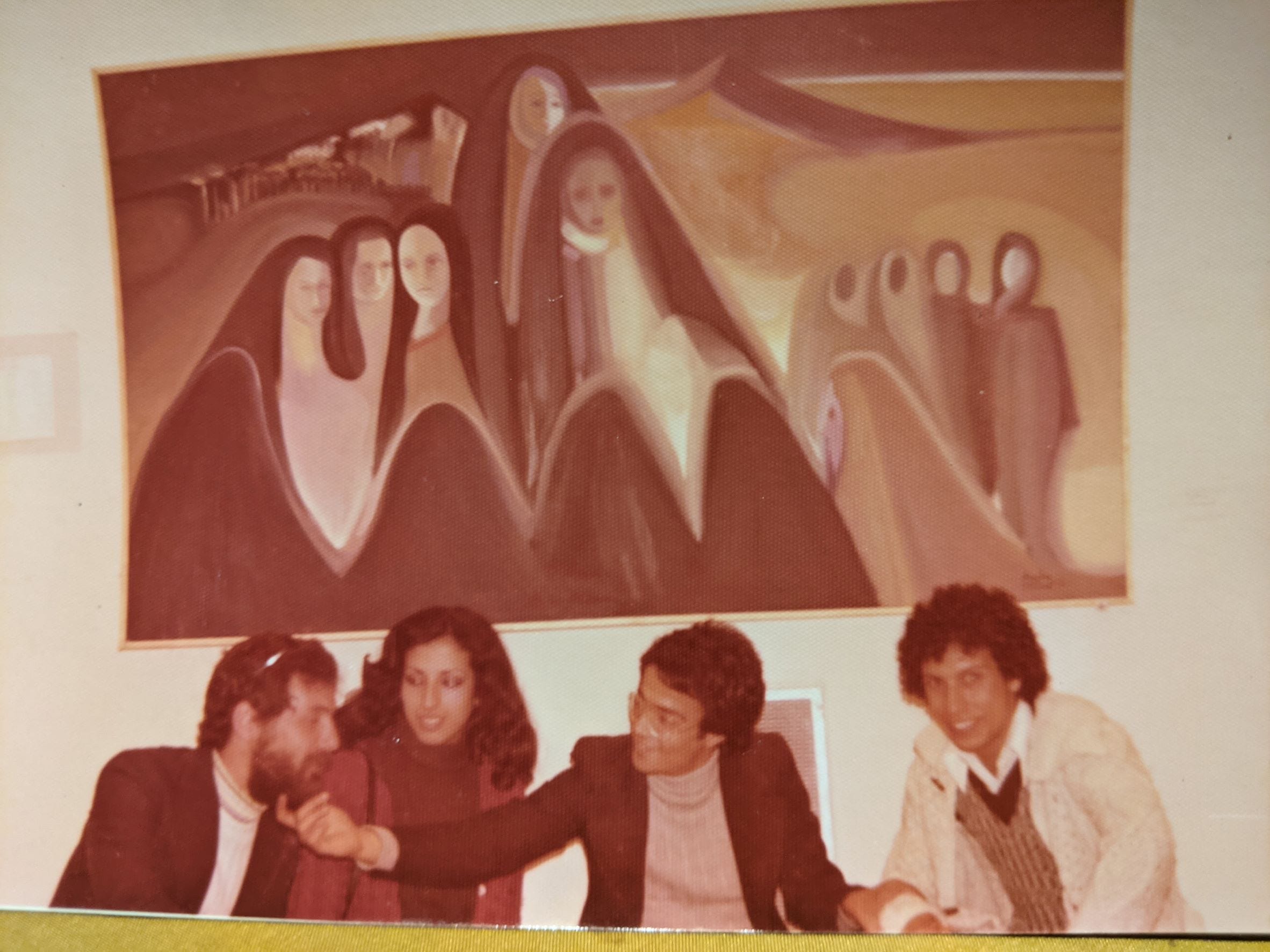
“Chedli Klibi, [who was] the minister of culture, made sure that we had as much training and practice, and the best of the best,” Rajaa Gharbi said. “So, actually the government subsidized teachers and trainings, also from overseas, from countries who are better than us in the field. So we had teachers who came from Eastern Europe, give us workshops that lasted sometimes a week, sometimes a day, until we got to the point where those workshops became actual exchanges, equal exchanges between us, the National Puppet Theatre Company, and any guests that came from the outside world. … The learning and the practice and the public performances were very integrated, interdisciplinary by both necessity and design. Because we have these cultural centers in Tunisia that were subsidized, for the most part, in fact [were subsidized] 100 percent by the government, where the older artists who are the masters or more or less getting to become masters in their field, they would be teaching the younger folks. And I was one of the younger folks. In these buildings you had a number of clubs. I mean, Langston Hughes Performing Arts Institute comes to mind, because it does have some aspects of interdisciplinary practice right there on the premises itself. So, we had photography, we had filmmaking, we had theater (theater acting and directing), we had literature, of course. All these clubs, each one of them had their own space, their own office, their own workshop in the same building. So, the learning was very interdisciplinary. And also, by necessity, because puppet theatre requires that. … Puppet theatre artists have to do everything. They have to learn everything. So, we were sculpting masks from scratch, absolute scratch. We made everything. We were designing the clothing, we were painting, we were constructing the set for each presentation. And each play had several sets, usually.”
I’ve inserted one of Rajaa Gharbi’s poems below:
Ce qui ne t’inspire pas t’expire/What doesn’t inspire you might freeze you
God Ibis-Thot
God of Lower Egypt
The God of writing
Son of Kush
we must retranslate your name
Ibis, who has been calling you Iblis?
And by the way
how did the sacred cow come
to appear in everybody’s Book?
Surat-Al Baqara’ for one is a long crossing:
Mother, Moooo, Ommmmmm
Buddist, Zen call to the creative powers of
the Great Mother of All. Yimma, Imma, حHayaa’,
حHawwa –Eva which was Heya, Hawaa’: breath, air
which apparently became Yahweh- god in Hebrew
and yahwaa in Arabic- to be in love or to fall down…
How interchangeable the fallings! Did the cow survive in
every body’s Book because of the sacredness of precious
life that milk symbolizes? –not as in the commonly
mistranslated “Al Jannatou tahta aqdaamel-Ommahaat”, or
the chastity imposed on mother Mariam, Maria, Mari, but
life itself as our collective mother?
Language detours
lapidary inscriptions on the psyche
of everything that breathes
let there be light!
let there be light!
Let there be light was and is the call of many an Africanmidwife, woman, man and child for the baby being born
to emerge out of the protective darkness of its mother’s
womb.
A natural Out-Come?
My beautiful poet, beloved brother
Lover of all Lovers
the moment must be ours entirely
and when, where shall it be?
by Sheba’s emerald landscapes or
Suleiman’s dream by the sea?
I am not writing scripts or
establishing-shots about our first convergence
they are writing themselves
What hilarity
Rajaa Gharbi
July 2004
(Published in The Griots of Ubuntu Anthology, Kenya 2022, in Men Aghani Aljousour; new book by the author, Medali Editions Tunisia 2018, in From Songs of a Grasshopper; poetry collection by the author, Kehna Publications, Washington State 2004. Excerpts have also been published in academic studies "The Circle of Departure and Return: A Reading of Men Aghani Aljousour by Dr. Fatma Lakhdhar, Jinanu’Alarif Tunis 2015, Raven Chronicles Literary Magazine; Celebration, Vol. 22 Washington State 2016, We Have Crossed Many Rivers; New Poetry From Africa anthology, Malthouse Press Lagos. All copyright Rajaa Gharbi.)
As our conversation progressed, we discussed the importance of language and how the monolingualism of the U.S. isolates it from non-English speaking artistic and literary communities around the globe. According to the Arab Publishers Union, there were approximately 315,000 books published in Arabic between 2015 and 2019, a good number of them novels. And in 2021 alone, there were 529,197 books published in Chinese. There are 6,500 languages spoken in the world, and many of those languages have lively literary scenes where authors only write in the local dialect. But because a mere 3% of the books sold in the United States are books that have been translated into English, Americans don’t have easy access to that global literature if it’s not in English. And that lack of access can foster an embarrassing amount of ignorance about people who speak differently, live differently, and see the world differently. Unfortunately, Gharbi has had first-hand experience with that ignorance which left her disoriented when she first arrived in the United States.
“So, I was completely decontextualized,” Gharbi said. “I mean, this goes for everybody who leaves their own artistic, cultural, historical, linguistic context. And they're parachuted by accident or by volition or whatever, into another context where they don't even know the language very well. … Without even being able to articulate the whole thing to myself, I intuitively, I understood enough English to know, to understand that this part of society definitely is not going to allow me in, no matter what I do.”
Today, Rajaa Gharbi has forged deeper connections in the art community in Seattle and beyond. Her work has appeared in GHAYYA Gallery, Art and Soul Gallery, Antioch University, the African American Art Museum, the Montana Historical Society, Center On Contemporary Art (COCA), Bellevue Art Museum, and more. Gharbi is the first North African English language poet in the United States to be published and awarded public funding for literary work (1986-2006) and she is currently exhibiting her artwork and sharing her poetry locally and internationally, including a recent reading tour in Chile. But Gharbi did note when she first moved to the U.S. with her husband at the time, certain cultural norms were a shock to her.
“Honestly, I had my first, my major, biggest, worst culture shock when it came to my encounter with the concept of the nuclear family, because I didn't have it,” said Gharbi. “It was something theoretical, I read in books, but you don't get a clue most of the time. That reality doesn't kick in, you know? So, I was still in complete shock from the isolation that happens when you are completely dependent on your own nucleus, the nuclear family. I wasn't used to it.”
She said she found inspiration and “food for the soul” by listening to NPR interviews of Black American Jazz artists who had faced discrimination but managed to thrive on their own terms. Eventually she connected to local African American, Native American, and other people of color artists and activists and attended various protests in her early years in Seattle. And as she began building connections deeper in the art world, she was faced with the idea that she should make her artwork ‘universal’.
“You hear this: ‘It's got to be universal first.’ What do you mean by universal? Do you mean Western European centered? Okay, from an art history perspective and aesthetics. That's what it means. ‘It’s just too specific:’ It means it has components that are not white, Western European and therefore maybe more homework is needed. This is my take on it. It is like more homework is needed to decode. Like a toolbox or something like that, or a dictionary. But art is informed by the land where people come from, before even you think about culture, which is created by humans. But it is first informed by the geography in which those humans grew up. Just like a Northwesterner is going to have influences of the Northwest here in the United States. No matter how much they tried to be, let's say, an east coast artist, something is going to seep in because it's in the cells. Your eyes saw it every day, the Northwest is so green. My palette changed gradually. Green is a lot more present than all the blues that I used to have in my work before I came here, because I'm Mediterranean, you know, African-Mediterranean. The sea is this thing I see every day. Every possible hue of blue, I know it because I grew up with it. I breathed it. So, that is the specificity that is denied in the name of the universalism.”
That demand for universalism contributes to a gross asymmetry in who gets literary works published or visual art exhibited in the United States. Here are some statistics.
· Between 1950 and 2018, only 5% of fiction books published in the U.S. were authored by people of color (POC).
· In 2018, that number improved significantly: 11% of fiction books published were written by POC authors.
However, in 2018 people of color were 39.9% of the U.S. population. And in 2020, that number increased to 42.2%, so there remains a large discrepancy in representation in the literary space.
And those statistics don’t improve in the visual art world.
A study by the Mellon Foundation, released in 2021, analyzed the collections and exhibitions of 40 major U.S. museums between 2010 and 2018. The study found that while the percentage of works by POC artists in museum collections had increased from 7% to 9% during that time period, the percentage of exhibitions featuring works by POC artists remained stagnant at around 7%.
And in a study of 31 museums, women artists only made up 11% of acquisitions with Black women artists making up 0.5% of acquisitions.
This severe underrepresentation often creates an expectation that the rare few who get access to major institutional support should create work solely or hyper-focused on the parts of their identity that are marginalized by the dominant society. This is a phenomenon that Rajaa Gharbi and other POC artists I’ve interviewed have experienced and observed.
“Let's say, a call for a national exhibition, and the theme is, victimhood as a woman from my part of the world. That closes the door for me already,” Gharbi said. “That predetermines what I want to talk about or what I'm going to paint or what film I'm going to make. Such calls actually did exist when I first came here. They were the crux of thematic parameters for the 80s and the 90s, when I was still new in the country. Now they’re not as explicit but they have become sort of embedded in certain psyches in the art world that there is an expectation to, for instance, identify by religion. I mean, as an African, as an African born and raised, as a person who grew up in an Arabic speaking country, which is also a large part of the African continent. As a poet, that's like clipping my wings. You can’t tell me what to write about. And unfortunately, quite frequently that is the expectation, that you are thematically bound to certain areas of thought.”
Gharbi acknowledged that there have been a lot of necessary and welcomed improvements in providing opportunities to POC artists across a broad range of disciplines. In Seattle specifically, I’ve noted that the city has launched or helped incubate several diversity and equity programs such as: The Ethnic Artist Roster, Building ArtSpace Equitably Certification, and Creative Advantage. And while major institutions such as The Baltimore Museum of Art, which committed to featuring only works by women artists or artists of color in its 2020-2022 exhibitions; and The Museum of Contemporary Art, Los Angeles (MOCA), which committed to increasing the diversity of its acquisitions, the range of creativity allowed POC artists is still often limited to themes about identity and marginalization. Because of this phenomenon, Gharbi said that artists with the means to do so, should consider building their own institutions, no matter how small.
“And perhaps if I have anything I can suggest is that while we defend individualism so much in this country, I am seeing a lot a lot of homogeneity, actually new kinds of homogeneity in a lot of artwork,” Gharbi said. “Precisely because of the question, the paradigm that I've been talking about now for the last half hour. … Organize exhibitions in your own house if you have to. Collect work that you think is very intelligent, and it is work that has a certain degree of independence of thought. … We need to cultivate that culture of collection. If you have to borrow some lighting in your own living room — and a lot of people have small living rooms — that's fine. Or [if you have a] spare room or something in your place, make that place a place of exhibition. Don't wait for the museums, because that place [you create] might become a museum at some point. It has happened in Black history in the United States and in American Indian history, and in lots of people’s history — those little things are museum now. And it's possible to make them bigger in your and our lifetime.”
Below are some corrections and clarifications to the March issue about Rajaa Gharbi.
Revision #1
Original: By the time she was in her second year of high school she was working at the OTEMA where she would spend seven years participating in local and national shows before moving to Morocco in 1977 and eventually getting married and moving to Seattle in the 1980s.
Revised: By the time she was in her second year of high school she was working at OTEMA almost daily, and would spend seven years participating in local and national shows before moving to Morocco and getting married in the 70's. She would eventually move to Seattle in the 1980s.
Revision #2
Original: She offered an example of how the letter ‘A’ in the English alphabet may actually have its origins in Tifinagh.
Revised: She offered an example of how the letter ‘A’ in the English alphabet may actually have its origins in Tifinagh, and looks like a ram's head in the Nabatean alphabet.
Revision #3
Original: Today, Rajaa Gharbi has forged deeper connections in the art community in Seattle and beyond. Her work has appeared in GHAYYA Gallery, Art and Soul Gallery, Antioch University, the African American Art Museum, the Montana Historical Society, and more. Gharbi is the first North African English language poet in the United States to be published and awarded public funding for literary work (1986-2006) and she is currently exhibiting her artwork and sharing her poetry locally and internationally, including a recent reading tour in Chile. But Gharbi did note when she first moved U.S. with her husband at the time, certain cultural norms were a shock to her.
Revised: Today, Rajaa Gharbi has forged deeper connections in the art community in Seattle and beyond. Her work has appeared in GHAYYA Gallery, Art and Soul Gallery, Antioch University, the African American Art Museum, the Montana Historical Society, Center On Contemporary Art (COCA), Bellevue Art Museum, and more. Gharbi is the first North African English language poet in the United States to be published and awarded public funding for literary work (1986-2006) and she is currently exhibiting her artwork and sharing her poetry locally and internationally, including a recent reading tour in Chile. But Gharbi did note when she first moved to the U.S. with her husband at the time, certain cultural norms were a shock to her.
Spanish Translation
Título: Disipando el mito del universalismo: una conversación con el artista Rajaa Gharbi
Resumen: ¿Algunas obras de arteson universales mientras que otras son de nicho? La artista interdisciplinaria Rajaa Gharbi explora nuestras conexiones a través del lenguaje y nuestra especificidad en la cultura y la geografía.
Desarrollándose como una muñeca cósmica de anidación, la vida creativa de Rajaa Gharbi está llena de una constelación de capas sorprendentes. Es pintora y poeta que fusiona letras e imágenes. Es cineasta, titiritera y sociolingüista que explora cómo los idiomas que hablamos afectan la forma en que vivimos, pensamos e imaginamos. Nació en Túnez en la década de 1950, durante una época de cambio político, dificultades económicas y la expansión de los derechos de las mujeres. Ahora, en Seattle durante los últimos 30+ años, Gharbi no parece estar disminuyendo la velocidad. En el transcurso de tres entrevistas, Rajaa Gharbi compartió su vida y su viaje creativo con Artists Up Close.
"La evolución de los idiomas, eso informa mi curiosidad", dijo Gharbi. "Ese es mi vehículo, por así decirlo. Es el coche que conduzco para explorar. Ese es realmente mi viaje por carretera: ahora puedo entender o descubrir, incluso el detalle mínimo, sobre cómo comenzamos a hablar".
Gharbi habla árabe, francés, inglés y algo de español, pero sus pinturas incorporan guiones de todo el mundo, incluido Tifinagh, que según ella es, según la investigación hasta ahora, el alfabeto más antiguo de África. Las inscripciones de Tifinagh se pueden encontrar en montañas de difícil acceso en África y se ha fechado en al menos 10.000 años de antigüedad. Y es esta antigüedad la que Gharbi utiliza para revisar los "orígenes de las cosas" en su obra de arte. Ella transforma las letras de tal manera que en su obra final puede ser difícil para el espectador reconocerlas como letras sin algún esfuerzo de su parte. Y es a través de este esfuerzo que Gharbi espera que el espectador entienda que todos estamos conectados a través del lenguaje escrito. Ella ofreció un ejemplo de cómo la letra 'A' en el alfabeto inglés puede tener sus orígenes en Tifinagh, y parece la cabeza de un carnero en el alfabeto nabateo.
"Tomas la letra 'A' y la inviertes, la pones al revés", dijo Rajaa Gharbi. "Así que la A mayúscula, la pones boca abajo y las dos barras de los lados las redondeas un poco. Escríbelos un poco en cursiva. ... Yverás que en realidad son los cuernos del carnero. Ahora, volvamos al antiguo Egipto. Y volvamos al alfabeto Tifinagh, que es de nuevo, el alfabeto africano del que estaba hablando que es muy antiguo, más antiguo que los jeroglíficos de Egipto. Verásque en realidad es el símbolo del carnero. Ahora volvemos a la historia, la historia espiritual de Egipto. ... Yverás que Baal, el dios Baal, que hay un significado específico asociado al carnero. Okay? That es una letra. Entonces, si observamos muchos de los alfabetos en el mundo, muchos de ellos han tomado prestadas o evolucionado letras de un alfabeto mucho más antiguo durante ciertas migraciones. "
Mucho antes de su propia migración de Túnez a Marruecos y, finalmente, a los Estados Unidos, la curiosidad de Rajaa Gharbi por el idioma, la cultura y el arte se alimentó de las profundas raíces artísticas de su familia. La abuela paterna de Gharbi fue la narradora personal del último rey tunecino, Sidi Moncef Bey y su familia. Y la madre de Gharbi, y uno de sus hermanos, crecieron en el palacio real después de que la sobrina del rey los adoptara cuando su madre murió de neumonía. Y fue el entorno creativo del palacio el que nutrió a los padres de Gharbi y los sostuvo en los años de escasez posteriores a la independencia de Túnez.
"Entonces, mi madre creció con influencias artísticas, influencias culturales y todo el palacio, que ahora es la casa del parlamento en Túnez", dijo Rajaa, explicando también que la familia de su madre tenía raíces bereberes indígenas. "Y salieron de esa posición cuando el Rey [Sidi Moncef Bey] fue asesinado por Francia, básicamente. Así, se convirtió en un mártir, para los militantes, para la liberación, para la independencia de Francia. Y todos los que eran aristocráticos de sangre o de profesión, como mi abuela, fueron degradados. Todo fue a la gente cuando nos convertimos en una república. Y todo cambió. ... Hasta el día de hoy, realmente estoy tratando de comprenderlo, desde haber sido criado en la riqueza de los palacios hasta convertirme, mi madre de todos modos, en una trabajadora y organizadora sindical. Se casó cuando él tenía 17 años, y vivió la vida de la mayoría de los tunecinos de la época, que apenas tenía dinero, apenas lo lograba, apenas sobrevivía porque el país estaba siendo reconstruido. Después de la independencia, las escuelas estaban siendo reconstruidas y la alfabetización, el trabajo, todo. Pero lo que mis padres no perdieron fueron sus pasiones y las cosas que realmente los salvaron en esos tiempos difíciles. Entonces, para mi madre, básicamente su patio de recreo en el palacio era hacer ropa, diseñar y hacer ropa. ... Así que ese patio de recreo, metafóricamente hablando, se convirtió en su trabajo, su trabajo, su profesión. Y desde el día en que abrí los ojos, más o menos, estaba con mi madre cuando dibujaba ropa y hacía ropa. Y la industria textil en Túnez, hace 20 años, era una de las mejores del mundo, la mejor en el sentido de variedad y fibra natural y diseños magníficos y la variedad de diseños. Y crecí caminando por las calles de la mitad de la ciudad que estaba cubierta con esa industria, con mi madre, diseñando y rediseñando en nuestra cabeza y en nuestras palabras, todo lo que vimos".
Para ganarse la vida, su madre cosía trajes escolares hechos a medida, trajes de tres piezas y vestidos para ocasiones especiales. Y como la familia no podía permitirse comprar juguetes, Gharbi creaba pequeñas marionetas con los restos de la obra de su madre.
"Y nunca me detuve desde ese momento", dijo Gharbi mientras relataba cómo comenzó su compromiso con la expresión artística. Era su primer día de escuela primariacuando sumaestra les dio a todos los estudiantes una tarea: debían pintar un objeto que les gustara y centrarse en el color y la línea. Rajaa Gharbi, de seis años, eligió pintar una alfombra. Un día, mientras su madre trabajaba en pedidos de costura en el patio de la casa, Gharbi se sentó cerca de ella y comenzó a pintar su propia versión de las alfombras de colores que eran una parte tan omnipresente del paisaje de la ciudad.
"Una de las cosas que veo todos los días caminando a la escuela o desde la escuela o en los vecindarios es básicamente las tiendas de alfombras", dijo Gharbi. "Los diseños muy, muy geométricos, los diseños nativos que se encuentran en todo el continente africano, y no hay excepción, Túnez los tiene, todos los del norte de África los tienen. "
Gharbi nos lleva de vuelta al patio donde estaba pintando una alfombra cuando era una niña de seis años mientras su madre trabajaba cerca.
"Y creo que mi padre o mi hermano o ambos nos llamaron y nosllamaron: 'Esla hora del almuerzo, deberías dejar de pintar ahora. ' Aunque no había terminado. Y mi madre dijo: 'De ningunamanera. Déjala terminar. Ella comerá cuando coma". Estedía fue el decisivo. Nofue una decisión. Yoera como: Estas son mis células, las células de mi cuerpo. Sienten que tienen que hacer estas cosas llamadas olor, línea y forma. Ynunca me detuve. Aunque mi trabajo ha tomado diferentes formas y he usado diferentes medios después de eso. "
Gharbi aprendería artes de títeres en OTEMA (Organization Nationale de Theatre de Marionnettes) en el Centro de Artes Ibn Rachiq, y aprendiz como cineasta en el cine-club Rue de Marseille en Túnez. Cuando estaba en su segundo año de escuela secundaria, trabajaba en OTEMA casi a diario, y pasaría siete años participando en espectáculos locales y nacionales antes de mudarse a Marruecos y casarse en los años 70. Eventualmente se mudaría a Seattle en la década de 1980.
"Chedli Klibi, [que era] el ministro de cultura, se aseguró de que tuviéramos tanta capacitación y práctica, y lo mejor de lo mejor", dijo Rajaa Gharbi. "Entonces, en realidad, el gobierno subsidió a maestros y capacitaciones, también del extranjero, de países que son mejores que nosotros en el campo. Así que tuvimos profesores que me dieron talleres que duraron a veces una semana, a veces un día, hasta que llegamos al punto en que esos talleres se convirtieron en intercambios reales, intercambios iguales entre nosotros, la Compañía Nacional de Padres y cualquier invitado que viniera del mundo exterior. ... Elaprendizaje, la práctica y las actuaciones públicas estaban muy integrados, interdisciplinarios tanto por necesidad como por diseño. Debido a que tenemos estos centros culturales en Túnez que fueron subsidiados, en su mayor parte, de hecho [fueron subsidiados] 100 por ciento por el gobierno, mientras que los artistas mayores que son los maestros o más o menos llegar a convertirse en maestros en su campo,estarían enseñando a los más jóvenes. Y yo era una de las personas más jóvenes. Enestos edificios yatenías varios clubes. Quiero decir, me viene a la mente el Instituto de Artes Escénicas Langston Hughes , porque tiene algunos aspectos de la práctica interdisciplinaria allí mismo en la premisa misma. Entonces, tuvimos fotografía, tuvimos cine, tuvimos teatro (actuación y dirección teatral), tuvimos literatura, por supuesto. Entodos estos clubes, cada uno de ellos tenía su propio espacio, su propia oficina, su propio taller en el mismo edificio. Entonces, el aprendizaje fue muy interdisciplinario. Y también, por necesidad, porque el teatro de títeres lo requiere. ... Los artistas de teatro de títeres tienen que hacer todo. Tienen que aprenderlo todo. Entonces, estábamos esculpiendo máscaras desde cero, desde cero absoluto. Hicimostodo. Estábamosdiseñando la ropa, estábamos pintando, estábamos construyendo el set para cada presentación. Y cada obra tenía varios sets, por lo general. "
He insertado uno de los poemas de Rajaa Gharbi a continuación:
Ce qui ne t’inspire pas t’expire
What doesn’t inspire you might freeze you

God Ibis-Thot
God of Lower Egypt
The God of writing
Son of Kush

we must retranslate your name
Ibis, who has been calling you Iblis?

And by the way

how did the sacred cow come
to appear in everybody’s Book?
Surat-Al Baqara’ for one is a long crossing:

Mother, Moooo, Ommmmmm
Buddist, Zen call to the creative powers of
the Great Mother of All. Yimma, Imma, حHayaa’,
حHawwa –Eva which was Heya, Hawaa’: breath, air
which apparently became Yahweh- god in Hebrew
and yahwaa in Arabic- to be in love or to fall down…

How interchangeable the fallings! Did the cow survive in
every body’s Book because of the sacredness of precious
life that milk symbolizes? –not as in the commonly
mistranslated “Al Jannatou tahta aqdaamel-Ommahaat”, or
the chastity imposed on mother Mariam, Maria, Mari, but
life itself as our collective mother?

Language detours
lapidary inscriptions on the psyche
of everything that breathes
let there be light!
let there be light!
Let there be light was and is the call of many an African
midwife, woman, man and child for the baby being born
to emerge out of the protective darkness of its mother’s
womb.

A natural Out-Come?

My beautiful poet, beloved brother
Lover of all Lovers
the moment must be ours entirely

and when, where shall it be?
by Sheba’s emerald landscapes or
Suleiman’s dream by the sea?

I am not writing scripts or
establishing-shots about our first convergence
they are writing themselves

What hilarity

Rajaa Gharbi
July 2004

(Published in The Griots of Ubuntu Anthology, Kenya 2022, in Men Aghani Aljousour; new book by the author, Medali Editions Tunisia 2018, in From Songs of a Grasshopper; poetry collection by the author, Kehna Publications, Washington State 2004. Excerpts have also been published in academic studies "The Circle of Departure and Return: A Reading of Men Aghani Aljousour by Dr. Fatma Lakhdhar, Jinanu’Alarif Tunis 2015, Raven Chronicles Literary Magazine; Celebration, Vol. 22 Washington State 2016, We Have Crossed Many Rivers; New Poetry From Africa anthology, Malthouse Press Lagos.                                               All copyright Rajaa Gharbi.
A medida que avanzaba nuestra conversación, discutimos la importancia del lenguaje y cómo el monolingüismo de los Estados Unidos lo aísla de las comunidades artísticas y literarias que no hablan inglés en todo el mundo. Según la Unión de Editores Árabes, hubo aproximadamente 315,000 libros publicados en árabe entre 2015 y 2019, un buen número de ellos novelas. Y solo en 2021, se publicaron 529,197 libros en chino. Se hablan 6.500 idiomas en el mundo, y muchos de esos idiomas tienen escenas literarias animadas donde los autores solo escriben en el dialecto local. Pero debido a que solo el 3% de los libros vendidos en los Estados Unidos son libros que han sido traducidos al inglés, los estadounidenses no tienen fácil acceso a esa literatura global si no está en inglés. Y esa falta de acceso puede fomentar una cantidad vergonzosa de ignorancia sobre las personas que hablan de manera diferente, viven de manera diferente y ven el mundo de manera diferente. Desafortunadamente, Gharbi ha tenido experiencia de primera mano con esa ignorancia que la dejó desorientada cuando llegó por primera vez a los Estados Unidos.
"Entonces, estaba completamente descontextualizado", dijo Gharbi. "Quiero decir, esto va para todos los que salen de su propio contexto artístico, cultural, histórico y lingüístico. Y son lanzados en paracaídas por accidente o por voluntad o lo que sea, a otro contexto donde ni siquiera conocen muy bien el idioma. ... Inclusosiendo capaz de articular todo el asunto para mí mismo, intuitivamente, entendí suficiente inglés para saber, para entender que esta parte de la sociedad definitivamente no me va a permitir entrar, no importa lo que haga".
Hoy, Rajaa Gharbi ha forjado conexiones más profundas en la comunidad artística en Seattle y más allá. Su trabajo ha aparecido en GHAYYA Gallery, Art and Soul Gallery, Antioch University, African American Art Museum, Montana Historical Society, Center On Contemporary Art (COCA), Bellevue Art Museum y más. Gharbi es la primera poetisa de lengua inglesa del norte de África en los Estados Unidos en ser publicada y recibió fondos públicos para obras literarias (1986-2006) y actualmente está exhibiendo su obra de arte y compartiendo su poesía a nivel local e internacional, incluida una reciente gira de lectura en Chile. Pero Gharbi notó que cuando se mudó por primera vez a los Estados Unidos con su esposo en ese momento, ciertas normas culturales fueron un shock para ella.
"Honestamente, tuve mi primer, mi mayor, más grande y peor choque cultural cuando se trataba de mi encuentro con el concepto de la familia nuclear, porque no lo tenía", dijo Gharbi. "Era algo teórico, leí en libros, pero no tienes ni idea la mayor parte del tiempo. Esa realidad no entra en acción, ¿sabes? Por lo tanto, todavía estaba en completo shock por el aislamiento que ocurre cuando dependes completamente de tu propio núcleo, la familia nuclear. No estaba acostumbrado".
Dijo que encontró inspiración y "alimento para el alma" al escuchar entrevistas de NPR de artistas negros estadounidenses de jazz que habían enfrentado discriminación pero que lograron prosperar en sus propios términos. E ventualmente se conectó con artistas y activistas afroamericanos, nativos americanos y otras personas de color locales y asistió a varias protestas en sus primeros años en Seattle. Y a medida que comenzó a construir conexiones más profundas en el mundo del arte, se enfrentó a la idea de que debería hacer que su obra de arte fuera "universal".
"Escuchas esto: 'Tiene que ser universal primero'. ¿Qué quieres decir con universal? ¿Te refieres a Europa Occidental centrada ened? Bueno, desde una perspectiva de historia del arte y estética. Eso es lo que significa. "Es demasiado específico": significa que tiene componentes que no son blancos, europeos occidentales y, por lo tanto, tal vez se necesite más tarea. Esta es mi opinión al respecto. Es como si se necesitara más tarea para decodificar. Como una caja de herramientas o algo así, o un diccionario. Pero el arte está informado por la tierra de donde viene la gente, incluso antes de pensar en la cultura, que es creada por los humanos. Pero primero está formado por la geografía en la que crecieron esos humanos. Just como un noroccidentaler va a tener influencias del noroeste aquí en los Estados Unidos. No importa cuánto intentaron ser, digamos, un artista de la costa este, todo se va a filtrar porque está en la celda. Tus ojos lo veían todos los días, el noroeste es verde. Lapaleta M y cambió gradualmente. El verde está mucho más presente que todos los azules que solía tener en mi trabajo antes de venir aquí, porque soy mediterráneo, ya sabes, africano-mediterráneo. Elmar es este thing que veo todos los días. Todos los tonos posibles de azul, lo sé porquecrecí con él. Lo respiré. Entonces, esa es la especificidad que se niega en nombre del universalismo".
Esa demanda de universalismo contribuye a una gran asimetría en quién publica obras literarias o exhibe arte visual en los Estados Unidos. Aquí hay algunas estadísticas.
· Entre 1950 y 2018, solo el 5% de los libros de ficción publicados en los Estados Unidos fueron escritos por personas de color (POC).
· En 2018, ese número mejoró significativamente: el 11% de los libros de ficción publicados fueron escritos por autores de POC.
Sin embargo, en 2018 las personas de color eran el 39.9% de la población de los Estados Unidos. Y en 2020, ese número aumentó a 42.2%, por lo que sigue habiendo una gran discrepancia en la representación en el espacio literario.
Y esas estadísticas no mejoran en el mundo de las artes visuales.
Un estudio de la Fundación Mellon, publicado en 2021, analizó las colecciones y exposiciones de 40 museos importantes de Estados Unidos entre 2010 y 2018. El estudio encontró que mientras que el porcentaje de obras de artistas POC en colecciones de museos había aumentado del 7% al 9% durante ese período de tiempo, el porcentaje de exposiciones con obras de artistas POC se mantuvo estancado en alrededor del 7%.
Y en un estudio de 31 museos, las mujeres artistas solo representaron el 11% de las adquisiciones y las artistas negras representaron el 0.5% de las adquisiciones.
Esta grave subrepresentación a menudo crea la expectativa de que los pocos que tienen acceso a un apoyo institucional importante deben crear un trabajo únicamente o hipercentrado en las partes de su identidad que están marginadas por la sociedad dominante. Este es un fenómeno que Rajaa Gharbi y otros artistas de POC que he entrevistado han experimentado y observado.
"Digamos, una convocatoria para una exposición nacional, y el tema es, victimización como mujer de mi parte del mundo. Eso ya me cierra la puerta", dijo Gharbi. "Eso predetermina de qué quiero hablar o qué voy a pintar o qué película voy a hacer. Tales llamadas realmente existían cuando vine aquí por primera vez. Fueron el quid de los parámetros temáticos para los años 80 y 90, cuando todavía era nuevo en el país. Ahora no son tan explícitos, pero se han incrustado en ciertas psiques en el mundo del arte que hay una expectativa de, por ejemplo, identificar por la religión. Quiero decir, como africano, como africano nacido y criado, como una persona que creció en un país de habla árabe, que también es una gran parte del continente africano. Como poeta,es como cortarme las alas. Yno puedo decirme sobre qué escribir. Y desafortunadamente, con bastante frecuencia esa es la expectativa, que estás atado temáticamente a ciertas áreas de pensamiento".
Gharbi reconoció que ha habido muchas mejoras necesarias y bienvenidas para brindar oportunidades a los artistas de POC en una amplia gama de disciplinas. En Seattle específicamente, he notado que la ciudad ha lanzado o ayudado a incubar varios programas de diversidad y equidad tales como: The Ethnic Artist Roster, Building ArtSpace Eequably Certification y Creative Advantage. Y mientras que las principales instituciones como el Museo de Arte de Baltimore, que se comprometió a presentar solo obras de mujeres artistas o artistas de color en sus exposiciones 2020-2022; y el Museo de Arte Contemporáneo, Los Ángeles (MOCA), que se comprometió a aumentar la diversidad de sus adquisiciones, el rango de creatividad permitido a los artistas POC sigue siendo a menudo limitado a temas sobre identidad y marginación. Debido a este fenómeno, Gharbi dijo que los artistas con los medios para hacerlo, deberían considerar la construcción de sus propias instituciones, sin importar cuán pequeñas sean.
"Y tal vez si tengo algo que puedo sugerir es que mientras defendemos tanto el individualismo en este país, estoy viendo mucha homogeneidad, en realidad nuevos tipos de homogeneidad en muchas obras de arte", dijo Gharbi. "Precisamente por la pregunta, el paradigma del que he estado hablando durante la última media hora. ... Organiza exposiciones en tu propia casa si es necesario. Es un trabajo que crees que es muy inteligente, y es un trabajo que tiene un cierto grado de independencia de pensamiento. ... Necesitamoscultivar esa cultura de la colección. Sitienes que pedir prestada algo de iluminación en tupropia sala de estar, y mucha gente tiene salas de estar pequeñas, eso es fin. O [si tienes una] habitación libre o algo en tu lugar, haz de ese lugar un lugar de exhibición. No esperes a los museos, porque el lugar [que creas] podría convertirse en un museo en algún momento. Ha sucedido en B lack historia en los Estados Unidos y en la historia de los indios americanos, y en la historia de muchas personas, esas pequeñas cosas son museo ahora. Y es posible hacerlos más grandes en tu vida y en la nuestra. "
French Translation
Titre : Dissiper le mythe de l’universalisme : une conversation avec l’artiste Rajaa Gharbi
Résumé: Certaines œuvres d’artsont-elles universelles alors que d’autres sont de niche? L’artiste interdisciplinaire Rajaa Gharbi explore nos liens à travers la langue et notre spécificité culturelle et géographique.
Se déroulant comme une poupée gigogne cosmique, la vie créative de Rajaa Gharbi est remplie d’une constellation de couches surprenantes. C’est une peintre et une poète qui fusionne le lettrage et l’imagerie. Elle est cinéaste, marionnettiste et sociolinguiste qui explore comment les langues que nous parlons influencent notre façon de vivre, de penser et d’imaginer. Elle est née en Tunisie dans les années 1950, à une époque de changement politique, de difficultés économiques et d’expansion des droits des femmes. Maintenant, à Seattle depuis 30+ ans, Gharbi ne semble pas ralentir. Au cours de trois entretiens, Rajaa Gharbi a partagé sa vie et son parcours créatif avec Artists Up Close.
« L’évolution des langues, cela nourrit ma curiosité », a déclaré Gharbi. « C’est mon véhicule, si vous voulez. C’est la voiture que je conduis pour explorer. C’est vraiment mon road trip : jepeux comprendre ou découvrir, même les moindres détails, comment nous avons commencé à parler. »
Gharbi parle arabe, français, anglais et un peu d’espagnol, mais ses peintures incorporent des écritures du monde entier, y compris le tifinagh, qui, selon les recherches effectuées jusqu’à présent, est le plus ancien alphabet d’Afrique. Les inscriptions tifinagh peuvent être trouvées sur les montagnes difficiles d’accès en Afrique et ont été datées d’au moins 10 000 ans. Et c’est cette ancienneté que Gharbi utilise pour revisiter les « origines des choses » dans ses œuvres. Elle transforme les lettres de telle sorte que dans son œuvre finale, il peut être difficile pour le spectateur de les reconnaître comme des lettres sans un effort de leur part. Et c’est grâce à cet effort que Gharbi espère que le spectateur comprendra que nous sommes tous connectés par le langage écrit. Elle a donné un exemple de la façon dont la lettre « A » dans l’alphabet anglais peut en fait avoir ses origines dans le tifinagh, et ressemble à une tête de bélier dans l’alphabet nabatéen.
« Vous prenez la lettre 'A' à l’envers, mettez-la à l’envers », a déclaré Rajaa Gharbi. « Donc, les majuscules A, vous le tournez à l’envers et les deux barres sur les côtés, vous les arrondissez un peu. Écrivez-les un peu cursivement. ... Vousverrez que ce sont en fait les cornes du bélier. Maintenant, revenons à l’Égypte ancienne. Et revenons à l’alphabet tifinagh, qui est encore une fois, l’alphabet africain dont je parlais qui est très ancien, plus ancien que les hiéroglyphes de l’Egypte. Vousverrez que c’est en fait le symbole du bélier. Maintenant, vous revenez à l’histoire, l’histoire spirituelle de l’Egypte. ... Vousverrez que Baal, le dieu Baal, a le dieu Baal, qu’il y a une signification spécifique attachée au bélier. Okay? C’estune lettre. Donc, si nous regardons beaucoup d’alphabets dans le monde, beaucoup d’entre eux ont emprunté ou développé des lettres d’un alphabet beaucoup plus ancien au cours de certaines migrations. "
Bien avant sa propre migration de Tunisie vers le Maroc et éventuellement les États-Unis, la curiosité de Rajaa Gharbi pour la langue, la culture et l’art a été nourrie par les racines artistiques profondes de sa famille. La grand-mère paternelle de Gharbi était la conteuse personnelle du dernier roi tunisien, Sidi Moncef Bey et de sa famille. Et la mère de Gharbi, et l’un de ses frères, ont grandi dans le palais royal après que la nièce du roi les ait adoptés lorsque leur mère est morte d’une pneumonie. Et c’est le milieu créatif du palais qui a nourri les parents de Gharbi et les a soutenus pendant les années de vaches maigres qui ont suivi l’indépendance tunisienne.
« Donc, ma mère a grandi avec des influences artistiques, culturelles et tout ce qui concerne le palais, qui est maintenant la maison du parlement en Tunisie », a déclaré Rajaa, expliquant également que la famille de sa mère avait des racines berbères indigènes. « Et ils sont partis de cette position quand le roi [Sidi Moncef Bey] a été tué par la France, en gros. Ainsi, il est devenu un martyr, pour les militants, pour la libération, pour l’indépendance de la France. Et tous ceux qui étaient aristocratiques par le sang ou par profession, comme ma grand-mère, ont été rétrogradés. Tout est allé au peuple quand nous sommes devenus une république. Et tout a changé. ... À ce jour, j’essaie vraiment de le comprendre – d’avoir été élevé dans la richesse des palais à devenir – ma mère en tout cas – une travailleuse et une organisatrice syndicale. Elle s’est mariée quand il avait 17 ans et a vécu la vie de la plupart des Tunisiens de l’époque, qui n’avait pratiquement pas d’argent, réussissant à peine, survivant à peine parce que le pays était en reconstruction. Après l’indépendance, les écoles ont été reconstruites et l’alphabétisation, le travail, tout. Mais ce que mes parents n’ont pas perdu, ce sont leurs passions et les choses qui les ont vraiment sauvés dans ces moments difficiles. Donc, pour ma mère, son terrain de jeu dans le palais était essentiellement de faire des vêtements, de concevoir et de fabriquer des vêtements. ... Ainsi, ce terrain de jeu, métaphoriquement parlant, est devenu son travail, son travail, son métier. Et depuis le jour où j’ai ouvert les yeux, à peu près, j’étais avec ma mère quand elle dessinait des vêtements et elle faisait des vêtements. Et l’industrie textile en Tunisie, il y a 20 ans, était l’une des meilleures au monde, la meilleure dans le sens de la variété et de la fibre naturelle et des designs magnifiques et de la variété des dessins. Et j’ai grandi en marchant dans les rues de la moitié de la ville couverte par cette industrie, avec ma mère, concevant et redessinant dans notre tête et dans nos mots, tout ce que nous voyions.
Pour gagner sa vie, sa mère cousait des tenues scolaires sur mesure, des costumes trois pièces et des robes pour des occasions spéciales. Et comme la famille n’avait pas les moyens d’acheter des jouets, Gharbi fabriquait de petites marionnettes à partir des restes de l’œuvre de sa mère.
« Et je n’ai jamais arrêté depuis ce moment », a déclaré Gharbi en racontant comment son engagement envers l’expression artistique a commencé. C’était son premier jour d’école primairelorsque son professeur a donné à tous les élèves un devoir: ils devaient peindre un objet qu’ils aimaient et se concentrer sur la couleur et la ligne. Rajaa Gharbi, six ans, a choisi de peindre un tapis. Un jour, alors que sa mère travaillait sur les commandes de couture dans la cour de la maison, Gharbi s’est assise près d’elle et a commencé à peindre sa propre version des tapis colorés qui étaient si omniprésents dans le paysage urbain.
« L’une des choses que je vois tous les jours à pied pour aller à l’école, à l’école ou dans les quartiers, ce sont essentiellement les magasins de tapis », a déclaré Gharbi. « Les dessins très, très géométriques, les dessins indigènes que vous trouvez partout sur le continent africain, et sans exception, la Tunisie les a, unegrande partie de l’Afrique du Nord les a. "
Gharbi nous ramène dans la cour où elle peignait un tapis à l’âge de six ans pendant que sa mère travaillait à proximité.
« Et je pense que mon père ou mon frère ou les deux nous ont appelés et ontdit: « C’estl’heure du déjeuner, tu devrais arrêter de peindre maintenant. ' Même si je n’avais pas fini. Et ma mère a dit : « Pasdu tout. Laissez-la finir. Elle mangera quand elle mangera. » Cejour a été décisif. Cen’était pas une décision. J’étaisjuste comme: Ce sont mes cellules, les cellules de mon corps. Ils ont l’impression qu’ils doivent faire ces choses appelées color, ligne et forme. Aet je n’ai jamais arrêté. Bien que mon travail ait pris différentes formes et que j’ai utilisé différents médiums par la suite. "
Gharbi a ensuite appris les arts de la marionnette à l’OTEMA (Organisation Nationale de Théâtre de Marionnettes) au Centre des Arts Ibn Rachiq, et a été apprenti cinéaste au Ciné-club de la rue de Marseille à Tunis. Au moment où elle était en deuxième année de lycée, elle travaillait à l’OTEMA presque tous les jours et passait sept ans à participer à des spectacles locaux et nationaux avant de déménager au Maroc et de se marier dans les années 70. Elle a finalement déménagé à Seattle dans les années 1980.
« Chedli Klibi, [qui était] le ministre de la Culture, s’est assuré que nous avions autant de formation et de pratique, et le meilleur des meilleurs », a déclaré Rajaa Gharbi. « Donc, en fait, le gouvernement a subventionné les enseignants et les formations, également de l’étranger, de pays qui sont meilleurs que nous sur le terrain. Nous avions donc des professeurs qui venaient d’Europe de l’Est, nous donnaient des ateliers qui duraient parfois une semaine, parfois une journée, jusqu’à ce que nous arrivions au point où ces ateliers sont devenus des échanges réels, des échanges égaux entre nous, la National P uppet Theatre Company, et tous les invités qui venaient du monde extérieur. ... L’apprentissage, la pratique et les représentations publiques étaient très intégrés, interdisciplinaires à la fois par nécessité et par conception. Parce que nous avons ces centres culturels en Tunisie qui ont été subventionnés, pour la plupart, en fait [ont été subventionnés] à 100% par le gouvernement, avec les artistes plus âgés qui sont les maîtres ou qui deviennent plus ou moins des maîtres dans leur domaine, ilsenseigneraient aux plus jeunes. Et j’étais l’une des plus jeunes. Dansces bâtiments, il yavait un certain nombre de clubs. Je veux dire, l’Institut des arts de la scène Langston Hughes me vient à l’esprit, parce qu’il a certains aspects de la pratique interdisciplinaire sur le site lui-même. Donc, nous avions la photographie, nous avions le cinéma, nous avions le théâtre (théâtre et mise en scène), nous avions la littérature, bien sûr. Danstous ces clubs, chacun d’entre eux avait son propre espace, son propre bureau, son propre atelier dans le même bâtiment. L’apprentissage a donc été très interdisciplinaire. Et aussi, par nécessité, parce que le théâtre de marionnettes l’exige. ... Les artistes de théâtre de marionnettes doivent tout faire. Ils doivent tout apprendre. Donc, nous sculptions des masques à partir de zéro, des égratignures absolues. Nousavons tout fait. Nousconcevions les vêtements, nous peignions, nous construisions le décor pour chaque présentation. Et chaque pièce avait plusieurs sets, habituellement. "
J’ai inséré un des poèmes de Rajaa Gharbi ci-dessous:
Ce qui ne t’inspire pas t’expire
What doesn’t inspire you might freeze you

God Ibis-Thot
God of Lower Egypt
The God of writing
Son of Kush

we must retranslate your name
Ibis, who has been calling you Iblis?

And by the way

how did the sacred cow come
to appear in everybody’s Book?
Surat-Al Baqara’ for one is a long crossing:

Mother, Moooo, Ommmmmm
Buddist, Zen call to the creative powers of
the Great Mother of All. Yimma, Imma, حHayaa’,
حHawwa –Eva which was Heya, Hawaa’: breath, air
which apparently became Yahweh- god in Hebrew
and yahwaa in Arabic- to be in love or to fall down…

How interchangeable the fallings! Did the cow survive in
every body’s Book because of the sacredness of precious
life that milk symbolizes? –not as in the commonly
mistranslated “Al Jannatou tahta aqdaamel-Ommahaat”, or
the chastity imposed on mother Mariam, Maria, Mari, but
life itself as our collective mother?

Language detours
lapidary inscriptions on the psyche
of everything that breathes
let there be light!
let there be light!
Let there be light was and is the call of many an African
midwife, woman, man and child for the baby being born
to emerge out of the protective darkness of its mother’s
womb.

A natural Out-Come?

My beautiful poet, beloved brother
Lover of all Lovers
the moment must be ours entirely

and when, where shall it be?
by Sheba’s emerald landscapes or
Suleiman’s dream by the sea?

I am not writing scripts or
establishing-shots about our first convergence
they are writing themselves

What hilarity

Rajaa Gharbi
July 2004

(Published in The Griots of Ubuntu Anthology, Kenya 2022, in Men Aghani Aljousour; new book by the author, Medali Editions Tunisia 2018, in From Songs of a Grasshopper; poetry collection by the author, Kehna Publications, Washington State 2004. Excerpts have also been published in academic studies "The Circle of Departure and Return: A Reading of Men Aghani Aljousour by Dr. Fatma Lakhdhar, Jinanu’Alarif Tunis 2015, Raven Chronicles Literary Magazine; Celebration, Vol. 22 Washington State 2016, We Have Crossed Many Rivers; New Poetry From Africa anthology, Malthouse Press Lagos.                                               All copyright Rajaa Gharbi.
Au fur et à mesure que notre conversation progressait, nous avons discuté de l’importance de la langue et de la façon dont le monolinguisme des États-Unis l’isole des communautés artistiques et littéraires non anglophones du monde entier. Selon l’Union des éditeurs arabes, environ 315 000 livres ont été publiés en arabe entre 2015 et 2019, dont un bon nombre de romans. Et rien qu’en 2021, 529 197 livres ont été publiés en chinois. Il y a 6 500 langues parlées dans le monde, et beaucoup de ces langues ont des scènes littéraires animées où les auteurs n’écrivent que dans le dialecte local. Mais parce que seulement 3% des livres vendus aux États-Unis sont des livres qui ont été traduits en anglais, les Américains n’ont pas facilement accès à cette littérature mondiale si elle n’est pas en anglais. Et ce manque d’accès peut favoriser une quantité embarrassante d’ignorance sur les personnes qui parlent différemment, vivent différemment et voient le monde différemment. Malheureusement, Gharbi a eu une expérience directe de cette ignorance qui l’a laissée désorientée à son arrivée aux États-Unis.
« Donc, j’étais complètement décontextualisé », a déclaré Gharbi. « Je veux dire, cela vaut pour tous ceux qui quittent leur propre contexte artistique, culturel, historique, linguistique. Et ils sont parachutés par accident ou par volonté ou autre, dans un autre contexte où ils ne connaissent même pas très bien la langue. ... Même si je suis capable de tout articuler à moi-même, j’ai intuitivement, j’ai compris assez d’anglais pour savoir, pour comprendre que cette partie de la société ne va certainement pas me permettre d’entrer, peu importe ce que je fais.
Aujourd’hui, Rajaa Gharbi a forgé des liens plus profonds dans la communauté artistique de Seattle et au-delà. Son travail a été présenté à la GHAYYA Gallery, à la Art and Soul Gallery, à l’Antioch University, au African American Art Museum, à la Montana Historical Society, au Center On Contemporary Art (COCA), au Bellevue Art Museum, etc. Gharbi est la première poète nord-africaine de langue anglaise aux États-Unis à être publiée et à recevoir un financement public pour son travail littéraire (1986-2006) et elle expose actuellement ses œuvres et partage sa poésie localement et internationalement, y compris une récente tournée de lecture au Chili. Mais Gharbi a noté que lorsqu’elle a déménagé pour la première fois aux États-Unis avec son mari à l’époque, certaines normes culturelles ont été un choc pour elle.
« Honnêtement, j’ai eu mon premier, mon plus grand, mon plus grand, mon pire choc culturel quand il s’est agi de ma rencontre avec le concept de la famille nucléaire, parce que je ne l’avais pas », a déclaré Gharbi. « C’était quelque chose de théorique, j’ai lu dans les livres, mais vous n’avez aucune idée la plupart du temps. Cette réalité n’entre pas en jeu, vous savez? Donc, j’étais encore sous le choc complet de l’isolement qui se produit lorsque vous êtes complètement dépendant de votre propre noyau, la famille nucléaire. Je n’y étais pas habitué.
Elle a dit qu’elle avait trouvé l’inspiration et « nourriture pour l’âme » en écoutant les interviews de NPR d’artistes de jazz noirs américains qui avaient été victimes de discrimination mais qui avaient réussi à prospérer selon leurs propres termes. Extérieurement, elle s’est connectée à des artistes et activistes afro-américains, amérindiens et d’autres personnes de couleur et a assisté à diverses manifestations dans ses premières années à Seattle. Et alors qu’elle commençait à établir des liens plus profonds dans le monde de l’art, elle a été confrontée à l’idée qu’elle devrait rendre son œuvre « universelle ».
« Vous entendez ceci : « Il faut d’abord que ce soit universel. » Qu’entendez-vous par universel ? Voulez-vous dire l’Europe occidentale centréeed? D’accord, du point de vue de l’histoire de l’art et de l’esthétique. C’est ce que cela signifie. « C’est tout simplement trop spécifique »: celasignifie qu’il a des composants qui ne sont pas blancs, d’Europe occidentale et donc peut-être que plus de devoirs sont nécessaires. C’est mon point de vue. C’est comme s’il fallait plus de devoirs pour décoder. Comme une boîte à outils ou quelque chose comme ça, ou un dictionnaire. Mais l’art est informé par la terre d’où viennent les gens, avant même de penser à la culture, qui est créée par les humains. Mais il est d’abord formépar la géographie dans laquelle ces humains ont grandi. Just comme un Nord-Ouest va avoir des influences du Nord-Ouest ici aux États-Unis. Peu importe à quel point ils ont essayé d’être, disons, un artiste de la côte Est, cequi va s’infiltrer parce que c’est dans la cellule. Vos yeux le voyaient tous les jours, le Nord-Ouest est vert s. My palette a changé progressivement. Le vert est beaucoup plus présent que tout le blues que j’avais dans mon travail avant de venir ici, parce que je suis méditerranéen, vous savez, afro-méditerranéen. Lamer est ce queje vois tous les jours. Toutes les teintes de bleu possibles, je les connais parce que j’ai grandi avec. Je l’ai respiré. Donc, c’est la spécificité qui est niée au nom de l’universalisme. »
Cette demande d’universalisme contribue à une asymétrie flagrante dans la publication d’œuvres littéraires ou l’exposition d’art visuel aux États-Unis. Voici quelques statistiques.
· Entre 1950 et 2018, seulement 5% des livres de fiction publiés aux États-Unis ont été écrits par des personnes de couleur (POC).
· En 2018, ce nombre s’est considérablement amélioré : 11 % des livres de fiction publiés ont été écrits par des auteurs de POC.
Cependant, en 2018, les personnes de couleur représentaient 39,9% de la population américaine. Et en 2020, ce nombre est passé à 42,2%, il reste donc un écart important dans la représentation dans l’espace littéraire.
Et ces statistiques ne s’améliorent pas dans le monde des arts visuels.
Une étude de la Fondation Mellon, publiée en 2021, a analysé les collections et les expositions de 40 grands musées américains entre 2010 et 2018. L’étude a révélé que si le pourcentage d’œuvres d’artistes POC dans les collections muséales était passé de 7% à 9% au cours de cette période, le pourcentage d’expositions présentant des œuvres d’artistes POC restait stagnant à environ 7%.
Et dans une étude portant sur 31 musées, les femmes artistes ne représentaient que 11 % des acquisitions, les femmes artistes noires représentant 0,5 % des acquisitions.
Cette grave sous-représentation crée souvent l’attente que les rares personnes qui ont accès à un soutien institutionnel majeur créent un travail uniquement ou hyper-concentré sur les parties de leur identité qui sont marginalisées par la société dominante. C’est un phénomène que Rajaa Gharbi et d’autres artistes POC que j’ai interviewés ont vécu et observé.
« Disons, un appel pour une exposition nationale, et le thème est, la victimisation en tant que femme de ma région du monde. Cela me ferme déjà la porte », a déclaré Gharbi. « Cela prédétermine de quoi je veux parler, ce que je vais peindre ou quel film je vais faire. De tels appels existaient en fait quand je suis arrivé ici. Ils étaient au cœur des paramètres thématiques des années 80 et 90, quand j’étais encore nouveau dans le pays. Maintenant, ils ne sont pas aussi explicites, mais ils sont devenus en quelque sorte ancrés dans certaines psychés du monde de l’art qu’il y a une attente, par exemple, d’identifier par la religion. Je veux dire, en tant qu’Africain, en tant qu’Africain né et élevé, en tant que personne qui a grandi dans un pays arabophone, qui est aussi une grande partie du continent africain. En tant que poète,c’est comme me couper les ailes. Vousne pouvez pas me dire sur quoi écrire. Et malheureusement, assez souvent, c’est l’attente, que vous êtes thématiquement lié à certains domaines de pensée.
Gharbi a reconnu qu’il y avait eu beaucoup d’améliorations nécessaires et bienvenues pour offrir des opportunités aux artistes POC dans un large éventail de disciplines. À Seattle en particulier, j’ai noté que la ville a lancé ou aidé à incuber plusieurs programmes de diversité et d’équité tels que: The Ethnic Artist Roster, Building ArtSpace Equitably Certification et Creative Advantage. Et si de grandes institutions telles que le Baltimore Museum of Art, qui s’est engagé à ne présenter que des œuvres de femmes artistes ou d’artistes de couleur dans ses expositions 2020-2022; et le Museum of Contemporary Art, Los Angeles (MOCA), qui s’est engagé à accroître la diversité de ses acquisitions, l’éventail de créativité permis aux artistes POC est toujours souvent limité à des thèmes sur l’identité et la marginalisation. En raison de ce phénomène, Gharbi a déclaré que les artistes ayant les moyens de le faire devraient envisager de construire leurs propres institutions, aussi petites soient-elles.
« Et peut-être que si j’ai quelque chose que je peux suggérer, c’est que bien que nous défendions tant l’individualisme dans ce pays, je vois beaucoup d’homogénéité, en fait de nouveaux types d’homogénéité dans beaucoup d’œuvres d’art », a déclaré Gharbi. « Précisément à cause de la question, du paradigme dont je parle maintenant depuis une demi-heure. ... Organisez des expositions dans votre propre maison si nécessaire. C’est un travail que vous pensez très intelligent, et c’est un travail qui a un certain degré d’indépendance de pensée. ... Nousdevons cultiver cette culture de la collection. Sivous devez emprunter un peu d’éclairage dans votre propre salon - et beaucoup de gens ont de petits salons - c’est fin. Ou [si vous avez] une chambre libre ou quelque chose à votre place, faites de cet endroit un lieu d’exposition. N’attendez pas les musées, car l’endroit [que vous créez] pourrait devenir un musée à un moment donné. Cela s’est produit dans l’histoire des États-Unis et dans l’histoire des Indiens d’Amérique, et dans l’histoire de beaucoup de gens – ces petites choses sont maintenant des musées. Et il est possible de les agrandir de votre vivant et de la nôtre. "
Arabic Translation
العنوان: تبديد أسطورة العالمية: حوار مع الفنانة رجاء غربي
ملخص: هل بعض الأعمال الفنيةعالمية بينما البعض الآخر متخصص؟ تستكشف الفنانة متعددة التخصصات رجاء غربي روابطنا من خلال اللغة وخصوصيتنا في الثقافة والجغرافيا.
تتكشف حياة رجاء غربي الإبداعية مثل دمية التعشيش الكونية ، وتمتلئ بكوكبة من الطبقات المدهشة. إنها رسامة وشاعرة تدمج الحروف والصور. إنها صانعة أفلام ومحرك دمى وعالمة لغوية اجتماعية تستكشف كيف تؤثر اللغات التي نتحدث بها على كيفية عيشنا وتفكيرنا وتخيلنا. ولدت في تونس في 1950s ، في وقت التغيير السياسي ، والصعوبات الاقتصادية ، وتوسيع حقوق المرأة. الآن ، في سياتل على مدى السنوات الماضية 30 + ، لا يبدو أن الغربي يتباطأ. على مدار ثلاث مقابلات، شاركت رجاء غربي حياتها ورحلتها الإبداعية مع Artists Up Close.
قال الغربي: "تطور اللغات ، هذا يوجه فضولي". "هذه هي سيارتي ، إذا صح التعبير. إنها السيارة التي أقودها لاستكشافها. هذه حقا رحلتي على الطريق: لقدفهمت أو اكتشفت ، حتى التفاصيل الدقيقة ، كيف بدأنا الحديث ".
تتحدث غربي العربية والفرنسية والإنجليزية وبعض الإسبانية لكن لوحاتها تتضمن نصوصا من جميع أنحاء العالم بما في ذلك تيفيناغ ، التي قالت إنها ، وفقا للبحث حتى الآن ، أقدم أبجدية في إفريقيا. يمكن العثور على نقوش تيفيناغ على الجبال التي يصعب الوصول إليها في إفريقيا وقد تم تأريخها ليصل تاريخها إلى 10000 عام على الأقل. وهذه هي القديمة التي تستخدمها غربي لإعادة النظر في "أصول الأشياء" في أعمالها الفنية. تقوم بتحويل الحروف بطريقة تجعل من الصعب على المشاهد التعرف عليها كرسائل في عملها الفني النهائي دون بذل بعض الجهد من جانبه. ومن خلال هذا الجهد يأمل الغربي أن يفهم المشاهد أننا جميعا متصلون من خلال اللغة المكتوبة. وقدمت مثالا على كيف أن الحرف "A" في الأبجدية الإنجليزية قد يكون له أصوله في تيفيناغ ، ويبدو وكأنه رأس كبش في الأبجدية النبطية.
قالت رجاء الغربي: "تأخذ الحرف "أ" وتراجعه، وتضعه رأسا على عقب". "لذا فإن الأحرف الكبيرة A ، تقلبها رأسا على عقب ويقوم الشريطان على الجانبين بتقريبهما قليلا. اكتبها بخط متصل قليلا. You سوف نرى أنه في الواقع قرون الكبش. الآن ، دعنا نعود إلى مصر القديمة. ودعونا نعود إلى أبجدية تيفيناغ، وهي مرة أخرى، الأبجدية الأفريقية التي كنت أتحدث عنها قديمة جدا، أقدم من الهيروغليفية في مصر. You'll نرى أنه في الواقع رمز الكبش. الآن تعود إلى التاريخ، التاريخ الروحي لمصر. ... سوفترى ثا تي بعل ، الإله بعل ، أن هناك معنى محددا مرتبطا بالكبش. أوكاذ؟ تيهات حرف واحد. لذلك ، إذا نظرنا إلى الكثير من الأبجدية في العالم ، فإن الكثير منها قد استعار أو طور حروفا من أبجدية أقدم بكثير خلال هجرات معينة. "
قبل وقت طويل من هجرتها من تونس إلى المغرب وفي نهاية المطاف الولايات المتحدة، كان فضول رجاء غربي حول اللغة والثقافة والفن يغذيه الجذور الفنية العميقة لعائلتها. كانت جدة الغربي لأبيه هي الراوية الشخصية لآخر ملوك تونس، سيدي منصف بك وعائلته. ونشأت والدة الغربي، وأحد أشقائها، في القصر الملكي بعد أن تبنتهما ابنة أخت الملك عندما توفيت والدتهما بسبب الالتهاب الرئوي. وكان الوسط الإبداعي للقصر هو الذي رعى والدي الغربي ودعمهما في السنوات العجاف التي أعقبت استقلال تونس.
وقالت رجاء "لذلك، نشأت والدتي مع التأثيرات الفنية والتأثيرات الثقافية وكل شيء في القصر، الذي أصبح الآن دار البرلمان في تونس"، موضحة أيضا أن عائلة والدتها لها جذور بربرية أصلية. "وذهبوا من هذا الموقف عندما قتل الملك [سيدي منصف بك] على يد فرنسا ، في الأساس. لذلك ، أصبح شهيدا ، للمسلحين ، من أجل التحرير ، من أجل الاستقلال عن فرنسا. وكل من كان أرستقراطيا بالدم أو بالمهنة ، مثل جدتي ، تم تخفيض رتبته. كل شيء ذهب إلى الشعب عندما أصبحنا جمهورية. وتغير كل شيء. ... حتى يومنا هذا ، أحاول حقا فهمها - من نشأتي في ثروة القصور إلى أن أصبح - والدتي على أي حال - عاملا ومنظما نقابيا. تزوجت عندما كان عمره 17 عاما، وعاشت حياة معظم التونسيين في ذلك الوقت، والتي كانت بالكاد تحمل أي أموال على الإطلاق، بالكاد تصنعها، بالكاد تعيش لأن البلاد كانت قيد إعادة البناء. بعد الاستقلال ، تم إعادة بناء المدارس ومحو الأمية والعمل وكل شيء. لكن ما لم يخسره والداي هو شغفهما والأشياء التي أنقذتهما حقا في تلك الأوقات الصعبة. لذلك ، بالنسبة لأمي ، كان ملعبها في القصر في الأساس هو صنع الملابس والتصميم وصنع الملابس. ... لذلك أصبح هذا الملعب ، مجازيا ، عملها ، وظيفتها ، مهنتها. ومنذ اليوم الذي فتحت فيه عيني ، إلى حد كبير ، كنت مع والدتي عندما كانت ترسم الملابس وتصنع الملابس. وصناعة النسيج في تونس ، قبل 20 عاما ، كانت واحدة من الأفضل في العالم ، الأفضل بمعنى التنوع والألياف الطبيعية والتصاميم الرائعة وتنوع التصاميم. ونشأت وأنا أسير في شوارع نصف المدينة التي كانت مغطاة بتلك الصناعة ، مع والدتي ، أصمم وأعاد تصميم في رؤوسنا وفي كلماتنا ، كل ما رأيناه ".
لكسب لقمة العيش ، قامت والدتها بخياطة ملابس مدرسية مصنوعة حسب الطلب ، وبدلات من ثلاث قطع ، وفساتين للمناسبات الخاصة. وبما أن الأسرة لم تستطع شراء الألعاب، كانت غربي تصنع دمى صغيرة من بقايا عمل والدتها اليدوي.
"ولم أتوقف أبدا منذ تلك اللحظة"، قالت غربي وهي تروي كيف بدأ التزامها بالتعبير الفني. كان هذا أول يوم لها في المدرسة الابتدائيةعندما كلف المعلم جميع الطلاب بواجب منزلي: كان عليهم رسم شيء يحبونه ، والتركيز على اللون والخط. اختارت رجاء غربي البالغة من العمر ست سنوات أن ترسم سجادة. في أحد الأيام ، كانت والدتها تعمل على أوامر الخياطة في فناء المنزل ، جلس الغربي بالقرب منها وبدأ في رسم نسختها الخاصة من السجاد الملون الذي كان جزءا في كل مكان من المناظر الطبيعية للمدينة.
قال الغربي: "أحد الأشياء التي أراها كل يوم سيرا على الأقدام إلى المدرسة أو من المدرسة أو في الأحياء هو في الأساس محلات السجاد". "التصاميم الهندسية جدا جدا، التصاميم المحلية التي تجدها في جميع أنحاء القارة الأفريقية، وليست استثناء، تونس لديها لهم، كلمن شمال أفريقيا لديهم. "
تأخذنا غربي إلى الفناء حيث كانت ترسم سجادة عندما كانت طفلة تبلغ من العمر ست سنوات بينما كانت والدتها تعملفي مكان قريب.
"وأعتقد أن والدي أو أخي أو كليهما اتصلوا بنا و said: 'أناتي وقت الغداء ، يجب أن تتوقف عن الرسم الآن. على الرغم من أنني لم أنتهي. فقالت أمي: "لاشيء. دعها تنتهي. سوف تأكل عندما تأكل. كان يوم القبعة هو الحاسم. لمأكن قرارا. كنتمثل: هذه هي خلاياي ، الخلايا في جسدي. يشعرون أنه يتعين عليهم القيام بهذه الأشياء التي تسمى color والخط والشكل. والثانيةلم أتوقف أبدا. على الرغم من أن عملي قد اتخذ أشكالا مختلفة واستخدمت وسائط مختلفة بعد ذلك. "
كان الغربي يتعلم فنون الدمى في OTEMA (المنظمة الوطنية لمسرح الماريونيت) في مركز ابن رشيق للفنون ، ويتدرب كمخرج أفلام في نادي Rue de Marseille Cine Club في تونس. بحلول الوقت الذي كانت فيه في سنتها الثانية من المدرسة الثانوية ، كانت تعمل في OTEMA يوميا تقريبا ، وستقضي سبع سنوات في المشاركة في العروض المحلية والوطنية قبل الانتقال إلى المغرب والزواج في 70. وقالت انها ستنتقل في نهاية المطاف إلى سياتل في 1980s.
قالت رجاء الغربي: "حرص الشاذلي كليبي، وزير الثقافة، على أن يكون لدينا أكبر قدر من التدريب والممارسة، وأفضل الأفضل". "لذلك ، في الواقع ، دعمت الحكومة المعلمين والدورات التدريبية ، أيضا من الخارج ، من دول أفضل منا في هذا المجال. لذلك كان لدينا معلمون من أوروبا الشرقية ، يقدمون لنا ورش عمل استمرت أحيانا أسبوعا ، وأحيانا يوما ، حتى وصلنا إلى النقطة التي أصبحت فيها ورش العمل هذه تبادلات فعلية ، تبادلات متساوية بيننا وبين شركة P uppet Theatre الوطنية ، وأي ضيوف جاءوا من العالم الخارجي. ... كان التعلم والممارسة والعروض العامة متكاملة للغاية ومتعددة التخصصات من حيث الضرورة والتصميم. لأن لدينا هذه المراكز الثقافية في تونس التي كانت مدعومة، في الغالب، في الواقع [كانت مدعومة] بنسبة 100 في المائة من قبل الحكومة، معالفنانين الأكبر سنا الذين هم أساتذة أو أكثر أو أقل ليصبحوا أساتذة في مجالهم، فإن تعليمالناس الأصغر سنا. وكنت واحدا من الشباب سنا. أنافي هذه المباني ذou كان لديك عدد من الأندية. أعني ، معهد لانغستون هيوز للفنون المسرحية يتبادر إلى الذهن ، لأنه يحتوي على بعض جوانب الممارسة متعددة التخصصات هناك على الفرضية نفسها. لذلك ، كان لدينا التصوير الفوتوغرافي ، كان لدينا صناعة الأفلام ، كان لدينا المسرح (التمثيل المسرحي والإخراج) ، كان لدينا الأدب ، بالطبع. فيهذه النوادي ، كان لكل واحد منهم مساحته الخاصة ، ومكتبه الخاص ، وورشة العمل الخاصة به في نفس المبنى. لذلك ، كان التعلم متعدد التخصصات للغاية. وأيضا ، بالضرورة ، لأن مسرح العرائس يتطلب ذلك. ... يجب على فناني مسرح العرائس القيام بكل شيء. عليهم أن يتعلموا كل شيء. لذلك ، كنا نحت الأقنعة من الصفر ، الصفر المطلق. Wه صنع كل شيء. كنانصمم الملابس ، كنا نرسم ، كنا نبني المجموعة لكل عرض تقديمي. وكان لكل مسرحية عدة مجموعات ، عادة. "
لقد أدخلت إحدى قصائد رجاء الغربي أدناه:
Ce qui ne t’inspire pas t’expire
What doesn’t inspire you might freeze you

God Ibis-Thot
God of Lower Egypt
The God of writing
Son of Kush

we must retranslate your name
Ibis, who has been calling you Iblis?

And by the way

how did the sacred cow come
to appear in everybody’s Book?
Surat-Al Baqara’ for one is a long crossing:

Mother, Moooo, Ommmmmm
Buddist, Zen call to the creative powers of
the Great Mother of All. Yimma, Imma, حHayaa’,
حHawwa –Eva which was Heya, Hawaa’: breath, air
which apparently became Yahweh- god in Hebrew
and yahwaa in Arabic- to be in love or to fall down…

How interchangeable the fallings! Did the cow survive in
every body’s Book because of the sacredness of precious
life that milk symbolizes? –not as in the commonly
mistranslated “Al Jannatou tahta aqdaamel-Ommahaat”, or
the chastity imposed on mother Mariam, Maria, Mari, but
life itself as our collective mother?

Language detours
lapidary inscriptions on the psyche
of everything that breathes
let there be light!
let there be light!
Let there be light was and is the call of many an African
midwife, woman, man and child for the baby being born
to emerge out of the protective darkness of its mother’s
womb.

A natural Out-Come?

My beautiful poet, beloved brother
Lover of all Lovers
the moment must be ours entirely

and when, where shall it be?
by Sheba’s emerald landscapes or
Suleiman’s dream by the sea?

I am not writing scripts or
establishing-shots about our first convergence
they are writing themselves

What hilarity

Rajaa Gharbi
July 2004

(Published in The Griots of Ubuntu Anthology, Kenya 2022, in Men Aghani Aljousour; new book by the author, Medali Editions Tunisia 2018, in From Songs of a Grasshopper; poetry collection by the author, Kehna Publications, Washington State 2004. Excerpts have also been published in academic studies "The Circle of Departure and Return: A Reading of Men Aghani Aljousour by Dr. Fatma Lakhdhar, Jinanu’Alarif Tunis 2015, Raven Chronicles Literary Magazine; Celebration, Vol. 22 Washington State 2016, We Have Crossed Many Rivers; New Poetry From Africa anthology, Malthouse Press Lagos.                                               All copyright Rajaa Gharbi.
مع تقدم محادثتنا ، ناقشنا أهمية اللغة وكيف أن أحادية اللغة في الولايات المتحدة تعزلها عن المجتمعات الفنية والأدبية غير الناطقة باللغة الإنجليزية في جميع أنحاء العالم. وفقا لاتحاد الناشرين العرب، كان هناك ما يقرب من 315000 كتاب منشور باللغة العربية بين عامي 2015 و 2019، عدد كبير منها روايات. وفي عام 2021 وحده ، تم نشر 529,197 كتابا باللغة الصينية. هناك 6500 لغة يتم التحدث بها في العالم ، والعديد من هذه اللغات لها مشاهد أدبية حية حيث يكتب المؤلفون باللهجة المحلية فقط. ولكن نظرا لأن 3٪ فقط من الكتب التي تباع في الولايات المتحدة هي كتب تمت ترجمتها إلى اللغة الإنجليزية ، فلن يتمكن الأمريكيون من الوصول بسهولة إلى هذا الأدب العالمي إذا لم يكن باللغة الإنجليزية. وهذا النقص في الوصول يمكن أن يعزز قدرا محرجا من الجهل بالأشخاص الذين يتحدثون بشكل مختلف ، ويعيشون بشكل مختلف ، ويرون العالم بشكل مختلف. لسوء الحظ، كانت لدى غربي تجربة مباشرة مع هذا الجهل الذي تركها مشوشة عندما وصلت لأول مرة إلى الولايات المتحدة.
قال الغربي: "لذلك، كنت خارج السياق تماما. "أعني ، هذا ينطبق على كل من يترك سياقه الفني والثقافي والتاريخي واللغوي. ويتم إنزالهم بالمظلة عن طريق الصدفة أو بمحض إرادتهم أو أي شيء آخر ، في سياق آخر حيث لا يعرفون اللغة جيدا. ... حتى لو كنت قادرا على التعبير عن الأمر برمته لنفسي ، فقد فهمت بشكل حدسي ما يكفي من اللغة الإنجليزية لأعرف ، لأفهم أن هذا الجزء من المجتمع بالتأكيد لن يسمح لي بالدخول ، بغض النظر عما أفعله ".
واليوم، أقامت رجاء غربي روابط أعمق في مجتمع الفن في سياتل وخارجها. ظهرت أعمالها في معرض غايا ، ومعرض الفن والروح ، وجامعة أنطاكية ، ومتحف الفن الأمريكي الأفريقي ، وجمعية مونتانا التاريخية ، ومركز الفن المعاصر (COCA) ، ومتحف بلفيو للفنون ، والمزيد. الغربي هي أول شاعرة باللغة الإنجليزية من شمال إفريقيا في الولايات المتحدة يتم نشرها ومنحها تمويلا عاما للأعمال الأدبية (1986-2006) وهي تعرض حاليا أعمالها الفنية وتشارك شعرها محليا ودوليا ، بما في ذلك جولة قراءة حديثة في تشيلي. لكن غربي لاحظت عندما انتقلت لأول مرة إلى الولايات المتحدة مع زوجها في ذلك الوقت، أن بعض الأعراف الثقافية كانت صدمة لها.
قال الغربي: "بصراحة، تعرضت لصدمتي الثقافية الأولى والكبرى والأكبر والأسوأ عندما يتعلق الأمر بلقائي مع مفهوم الأسرة النووية، لأنني لم أكن أملكها". "لقد كان شيئا نظريا ، قرأت في الكتب ، لكنك لا تحصل على فكرة في معظم الأوقات. هذا الواقع لا يبدأ ، هل تعلم؟ لذلك ، كنت لا أزال في حالة صدمة كاملة من العزلة التي تحدث عندما تعتمد اعتمادا كليا على نواتك ، الأسرة النووية. لم أكن معتادا على ذلك".
وقالت إنها وجدت الإلهام و "غذاء الروح" من خلال الاستماع إلى مقابلات NPR مع فناني الجاز الأمريكيين السود الذين واجهوا التمييز ولكنهم تمكنوا من الازدهار بشروطهم الخاصة. Eظاهريا ، تواصلت مع الأمريكيين من أصل أفريقي المحليين والأمريكيين الأصليين وغيرهم من الفنانين والناشطين الملونين وحضرت احتجاجات مختلفة في سنواتها الأولى في سياتل. وعندما بدأت في بناء روابط أعمق في عالم الفن ، واجهت فكرة أنها يجب أن تجعل أعمالها الفنية "عالمية".
"تسمع هذا: "يجب أن تكون عالمية أولا". ماذا تقصد بالعالمية؟ هل تقصد مركز أوروبا الغربية؟ حسنا ، من منظور تاريخ الفن والجماليات. هذا ما يعنيه. "إنه محدد للغاية:" أعنيأنه يحتوي على مكونات ليست بيضاء ، أوروبا الغربية ، وبالتالي ربما تكون هناك حاجة إلى مزيد من الواجبات المنزلية. هذا هو رأيي في ذلك. يبدو الأمر كما لو أن هناك حاجة إلى مزيد من الواجبات المنزلية لفك الشفرة. مثل صندوق الأدوات أو شيء من هذا القبيل ، أو القاموس. لكن الفن مستوحى من الأرض التي يأتي منها الناس ، قبل أن تفكر في الثقافة ، التي يخلقها البشر. لكنها الأولى فيتشكيل الجغرافيا التي نشأ فيها هؤلاء البشر. Just مثل الشمال الغربي إيه سيكون لها تأثيرات الشمال الغربي هنا في الولايات المتحدة. بغض النظر عن مدى محاولتهم أن يكونوا ، دعنا نقول ، فنان الساحل الشرقي ، فإن ال omething سوف تتسرب إلى الداخل لأنها في الزنزانة. رأته عيناك كل يوم ، الشمال الغربي أخضر. تغيرت لوحة My تدريجيا. الأخضر أكثر حضورا بكثير من كل البلوز الذي اعتدت أن أمتلكه في عملي قبل مجيئي إلى هنا ، لأنني من البحر الأبيض المتوسط ، كما تعلمون ، أفريقي متوسطي. البحرهو هذا الذيأراه كل يوم. كل لون ممكن من اللون الأزرق ، وأنا أعلم أنه بلأنني نشأت معها. تنفسته. إذن، هذه هي الخصوصية التي يتم إنكارها باسم العالمية".
يساهم هذا الطلب على العالمية في عدم تناسق جسيم في من يحصل على الأعمال الأدبية المنشورة أو الفن المرئي المعروض في الولايات المتحدة. فيما يلي بعض الإحصائيات.
· بين عامي 1950 و 2018 ، تم تأليف 5٪ فقط من الكتب الخيالية المنشورة في الولايات المتحدة من قبل أشخاص ملونين (POC).
· في عام 2018 ، تحسن هذا الرقم بشكل ملحوظ: 11٪ من الكتب الخيالية المنشورة كتبها مؤلفو POC.
ومع ذلك ، في عام 2018 ، كان الأشخاص الملونون 39.9٪ من سكان الولايات المتحدة. وفي عام 2020، ارتفع هذا الرقم إلى 42.2٪، لذلك لا يزال هناك تباين كبير في التمثيل في الفضاء الأدبي.
وهذه الإحصائيات لا تتحسن في عالم الفنون البصرية.
قامت دراسة أجرتها مؤسسة ميلون ، تم إصدارها في عام 2021 ، بتحليل مجموعات ومعارض 40 متحفا أمريكيا رئيسيا بين عامي 2010 و 2018. وجدت الدراسة أنه في حين أن النسبة المئوية لأعمال فناني POC في مجموعات المتاحف قد زادت من 7٪ إلى 9٪ خلال تلك الفترة الزمنية ، ظلت النسبة المئوية للمعارض التي تضم أعمالا لفناني POC راكدة عند حوالي 7٪.
وفي دراسة أجريت على 31 متحفا ، شكلت الفنانات 11٪ فقط من عمليات الاستحواذ بينما شكلت الفنانات السود 0.5٪ من عمليات الاستحواذ.
غالبا ما يخلق هذا النقص الشديد في التمثيل توقعا بأن القلة النادرة التي تحصل على دعم مؤسسي كبير يجب أن تخلق عملا فقط أو تركز بشكل مفرط على أجزاء هويتها المهمشة من قبل المجتمع المهيمن. هذه ظاهرة اختبرتها ولاحظتها رجاء غربي وغيرها من فناني POC الذين قابلتهم.
«دعنا نقول، دعوة لمعرض وطني، والموضوع هو، الضحية كامرأة من الجزء الذي أعيش فيه من العالم. هذا يغلق الباب أمامي بالفعل". «هذا يحدد مسبقا ما أريد التحدث عنه أو ما سأرسمه أو الفيلم الذي سأصنعه. مثل هذه المكالمات كانت موجودة بالفعل عندما جئت إلى هنا لأول مرة. كانت جوهر المعلمات المواضيعية ل 80s و 90s ، عندما كنت لا أزال جديدا في البلاد. الآن هم ليسوا صريحين لكنهم أصبحوا نوعا ما جزءا لا يتجزأ من بعض النفسيات في عالم الفن الذي هناك توقع ، على سبيل المثال ، تحديده من خلال الدين. أعني ، كأفريقي ، كأفريقي ولد ونشأ ، كشخص نشأ في بلد يتحدث العربية ، وهو أيضا جزء كبير من القارة الأفريقية. كشاعر ، تيقبعة مثل قص جناحي. لاأستطيع أن تخبرني ماذا أكتب عنه. ولسوء الحظ ، في كثير من الأحيان هذا هو التوقع ، أنك ملزم موضوعيا بمجالات معينة من التفكير ".
أقر الغربي بأن هناك الكثير من التحسينات الضرورية والمرحب بها في توفير الفرص لفناني POC عبر مجموعة واسعة من التخصصات. في سياتل على وجه التحديد ، لاحظت أن المدينة قد أطلقت أو ساعدت في احتضان العديد من برامج التنوع والإنصاف مثل: قائمة الفنانين العرقيين ، وبناء شهادة ArtSpace بشكل عادل ، والميزة الإبداعية. وبينما لا تزال المؤسسات الكبرى مثل متحف بالتيمور للفنون ، التي التزمت بعرض أعمال الفنانات أو الفنانين الملونين فقط في معارضها 2020-2022 ؛ ومتحف الفن المعاصر ، لوس أنجلوس (MOCA) ، الذي التزم بزيادة تنوع مقتنياته ، فإن نطاق الإبداع المسموح به لفناني POC لا يزال غالبا ما تقتصر على مواضيع حول الهوية والتهميش. وبسبب هذه الظاهرة، قال الغربي إن الفنانين الذين لديهم الوسائل للقيام بذلك، يجب أن يفكروا في بناء مؤسساتهم الخاصة، مهما كانت صغيرة.
وقال الغربي: "ربما إذا كان لدي أي شيء يمكنني أن أقترحه هو أنه بينما ندافع عن الفردية كثيرا في هذا البلد ، أرى الكثير من التجانس ، في الواقع أنواع جديدة من التجانس في الكثير من الأعمال الفنية". "على وجه التحديد بسبب السؤال ، النموذج الذي كنت أتحدث عنه الآن خلال النصف ساعة الماضية. ... تنظيم المعارض في منزلك إذا كان لديك ذلك. Collect العمل الذي تعتقد أنه ذكي جدا ، وهو عمل يتمتع بدرجة معينة من استقلالية الفكر. ... نحنبحاجة إلى زراعة ثقافة الجمع هذه. إذاكان عليك استعارة بعض الإضاءة في غرفة المعيشة الخاصة بك - والكثير من الناس لديهم غرف معيشة صغيرة - هذا هو fine. أو [إذا كان لديك] غرفة احتياطية أو شيء ما في مكانك ، اجعل هذا المكان مكانا للعرض. لا تنتظر المتاحف ، لأن المكان الذي تنشئه قد يصبح متحفا في مرحلة ما. لقد حدث ذلك في تاريخ B نقص في الولايات المتحدة وفي تاريخ الهنود الأمريكيين ، وفي تاريخ الكثير من الناس - هذه الأشياء الصغيرة هي متحف الآن. ومن الممكن جعلها أكبر في حياتك وحياتنا. "
Swahili Translation
Kichwa cha habari: Kuondoa Hadithi ya Universalism: Mazungumzo na Msanii Rajaa Gharbi
Muhtasari: Je, baadhi ya kaziza sanaa ni za ulimwengu wote wakati zingine ni niche? Msanii wa interdisciplinary Rajaa Gharbi anachunguza uhusiano wetu kupitia lugha na upekee wetu katika utamaduni na jiografia.
Ikijitokeza kama mwanasesere wa kutagia cosmic, maisha ya ubunifu ya Rajaa Gharbi yamejaa kundi la tabaka za kushangaza. Yeye ni mchoraji na mshairi anayeunganisha herufi na picha. Yeye ni mtengenezaji wa filamu, puppeteer, na mwanasosholingu ambaye anachunguza jinsi lugha tunazozungumza zinavyoathiri jinsi tunavyoishi, kufikiri, na kufikiria. Alizaliwa nchini Tunisia katika miaka ya 1950, wakati wa mabadiliko ya kisiasa, hali ngumu ya kiuchumi, na upanuzi wa haki za wanawake . Sasa, huko Seattle kwa miaka 30+ iliyopita, Gharbi haionekani kupungua. Katika kipindi cha mahojiano matatu, Rajaa Gharbi alishiriki maisha yake na safari yake ya ubunifu na Wasanii Up Close.
"Mageuzi ya lugha, ambayo yanafahamisha udadisi wangu," Gharbi alisema. "Hilo ndilo gari langu, kama utafanya hivyo. Ni gari ninaloendesha kuchunguza. Hiyo ni kweli safari yangu ya barabara: How napata kuelewa au kujua, hata minute maelezo, kuhusu jinsi tulivyoanza kuzungumza."
Gharbi anazungumza Kiarabu, Kifaransa, Kiingereza, na baadhi ya Kihispania lakini michoro yake inajumuisha maandishi kutoka duniani kote ikiwa ni pamoja na Tifinagh, ambayo alisema ni, kulingana na utafiti hadi sasa, alfabeti kongwe zaidi barani Afrika. Maandishi ya Tifinagh yanaweza kupatikana katika hali ngumu ya kufikia milima barani Afrika na yamekadiriwa kuwa na umri usiopungua miaka 10,000. Na ni kale hii ambayo Gharbi hutumia kurejelea "asili ya vitu" katika kazi yake ya sanaa. Anabadilisha herufi kwa namna ambayo katika mchoro wake wa mwisho inaweza kuwa vigumu kwa mtazamaji kuzitambua kama barua bila juhudi fulani kwa upande wake. Na ni kupitia juhudi hizi ambapo Gharbi anatumai mtazamaji ataelewa kuwa sote tumeunganishwa kupitia lugha ya maandishi. Alitoa mfano wa jinsi herufi 'A' katika alfabeti ya Kiingereza inaweza kuwa na asili yake katika Tifinagh, na inaonekana kama kichwa cha kondoo katika alfabeti ya Nabatean.
"Unachukua herufi 'A' ibadilishe, iweke juu chini," Rajaa Gharbi alisema. "Kwa hiyo uppercase A, unaigeuza juu chini na baa mbili pande unazizunguka kidogo. Waandike kwa laana kidogo. ... You ataona kwamba kweli ni pembe za kondoo. Sasa, hebu turudi Misri ya kale. Na turudi kwenye alfabeti ya Tifinagh, ambayo ni tena, alfabeti ya Kiafrika niliyokuwa naizungumzia ambayo ni ya zamani sana, ya zamani kuliko hieroglyphs ya Misri. You'll utaona kwamba ni kweli ni alama ya kondoo. Sasa unarudi kwenye historia, historia ya kiroho ya Misri. ... You ataona that Baali, mungu Baali, kwamba kuna maana maalum iliyoambatanishwa na kondoo. Okay? Baruamoja ya kofia. Kwa hivyo, tukiangalia alfabeti nyingi duniani, nyingi zimekopa au kubadilisha herufi kutoka alfabeti ya zamani zaidi wakati wa uhamiaji fulani. "
Muda mrefu kabla ya kuhama kwake mwenyewe kutoka Tunisia kwenda Morrocco na hatimaye Marekani, udadisi wa Rajaa Gharbi kuhusu lugha, utamaduni na sanaa ulikuzwa na mizizi mirefu ya kisanii ya familia yake. Bibi mzaa baba wa Gharbi alikuwa mwandishi wa hadithi binafsi wa Mfalme wa mwisho wa Tunisia, Sidi Moncef Bey na familia yake. Na mama yake Gharbi, na mmoja wa ndugu zake, walikulia katika kasri la kifalme baada ya mpwa wa Mfalme kuwachukua wakati mama yao alipofariki kwa homa ya mapafu. Na ilikuwa ni wanamgambo wa ubunifu wa ikulu ambao waliwalea wazazi wa Gharbi na kuwaendeleza katika miaka iliyoegemea baada ya uhuru wa Tunisia.
"Kwa hivyo, mama yangu alikua na ushawishi wa kisanii, ushawishi wa kitamaduni, na kila kitu cha ikulu, ambayo sasa ni nyumba ya bunge nchini Tunisia," Rajaa alisema, pia akielezea kwamba familia ya mama yake ilikuwa na mizizi ya asili ya Berber. "Na walitoka katika nafasi hiyo wakati Mfalme [Sidi Moncef Bey] alipouawa na Ufaransa, kimsingi. Hivyo, akawa mfiadini, kwa ajili ya wanamgambo, kwa ajili ya ukombozi, kwa ajili ya uhuru kutoka Ufaransa. Na kila mtu aliyekuwa na damu au kwa taaluma, kama bibi yangu, alishushwa cheo. Kila kitu kilikwenda kwa wananchi tulipokuwa jamhuri. Na kila kitu kilibadilika. ... Hadi leo, ninajaribu sana kuielewa - kutokana na kulelewa katika utajiri wa majumba hadi kuwa - mama yangu hata hivyo - mfanyakazi na mratibu wa muungano. Aliolewa alipokuwa na umri wa miaka 17, na aliishi maisha ya Watunisia wengi wa wakati huo, ambayo haikuwa na pesa yoyote hata kidogo, kwa shida tu kuifanya, haiwezi kuishi kwa sababu nchi ilikuwa inajengwa upya. Baada ya uhuru, shule zilikuwa zikijengwa upya na kujua kusoma na kuandika, kazi, kila kitu. Lakini kile ambacho wazazi wangu hawakupoteza ni tamaa zao na vitu ambavyo viliwaokoa sana katika nyakati hizo ngumu. Kwa hiyo, kwa mama yangu, kimsingi uwanja wake wa michezo katika ikulu ulikuwa ukitengeneza nguo, kubuni na kutengeneza nguo. ... Hivyo uwanja huo wa michezo, kuzungumza kwa sitiari, ukawa kazi yake, kazi yake, taaluma yake. Na tangu siku nilipofumbua macho, mengi sana, nilikuwa na mama yangu alipovua nguo na akatengeneza nguo. Na sekta ya nguo nchini Tunisia, miaka 20 iliyopita, ilikuwa moja ya bora zaidi ulimwenguni, bora zaidi kwa maana ya miundo mbalimbali na ya asili ya nyuzi na miundo mizuri na miundo mbalimbali. Na nilikua nikitembea katika mitaa ya nusu ya jiji iliyokuwa imefunikwa na sekta hiyo, pamoja na mama yangu, kubuni na kuunda upya kichwani mwetu na kwa maneno yetu, kila kitu tulichokiona."
Ili kujipatia kipato, mama yake alishona mavazi ya shule yaliyotengenezwa kwa desturi, suti za vipande vitatu, na gauni kwa hafla maalum. Na kwa kuwa familia haikuweza kumudu kununua vitu vya kuchezea, Gharbi angetengeneza vibaraka wadogo kutoka kwa mabaki ya kazi ya mikono ya mama yake.
"Na sijawahi kuacha tangu wakati huo," alisema Gharbi huku akisimulia jinsi kujitolea kwake katika kujieleza kisanii kulivyoanza. Ilikuwa siku yake ya kwanza ya schoo ya msingil wakati mwalimu wa her aliwapa wanafunzi wote kazi ya nyumbani: Walipaswa kuchora kitu walichopenda, na kuzingatia rangi na mstari. Rajaa Gharbi mwenye umri wa miaka sita aliamua kupaka rangi. Siku moja, mama yake alifanya kazi ya kushona amri katika ua wa kaya, Gharbi alikaa karibu naye na kuanza kuchora toleo lake mwenyewe la rugs za rangi ambazo zilikuwa sehemu kubwa ya mandhari ya jiji.
"Moja ya vitu ambavyo naviona kila siku vikitembea kwenda shuleni au kutoka shuleni au vitongojini kimsingi ni maduka ya kokoto," alisema Gharbi. "Ubunifu wa kijiometri sana, miundo ya asili ambayo unaipata kote barani Afrika, na hakuna ubaguzi, Tunisia inayo,ll ya Afrika Kaskazini inayo. "
Gharbi anaturudisha uani ambako alikuwa akichora rangi kama msichana wa miaka sita wakati mama yake akifanya kazikaribu.
"Na nadhani baba yangu au kaka yangu au wote wawili walituita [kwetu] na said: 'Sinachakula cha mchana, unapaswa kuacha kuchora sasa. "Ingawa sikuwa nimemaliza. Mama yangu akasema, 'No njia. Mwacheni amalize. Atakula wakati atakapokula." Sikuya kofia ilikuwa ya maamuzi [moja]. Sikuwana uamuzi. Nilikuwakama vile: Hizi ni seli zangu, seli katika mwili wangu. Wanahisi kama lazima wafanye vitu hivi vinavyoitwa color, mstari na umbo. Ndsikuwahi kuacha. Ingawa kazi yangu imechukua aina tofauti na nimetumia njia tofauti baada ya hapo. "
Gharbi angeendelea kujifunza sanaa ya vibaraka katika OTEMA (Organization Nationale de Theatre de Marionnettes) katika Kituo cha Sanaa cha Ibn Rachiq, na mwanafunzi kama mtengenezaji wa filamu na klabu ya Rue de Marseille Cine huko Tunis. Wakati alipokuwa katika mwaka wake wa pili wa shule ya upili alikuwa akifanya kazi katika OTEMA karibu kila siku, na angetumia miaka saba kushiriki katika maonyesho ya ndani na ya kitaifa kabla ya kuhamia Morocco na kuolewa katika miaka ya 70. Hatimaye alihamia Seattle katika miaka ya 1980.
"Chedli Klibi, [ambaye alikuwa] waziri wa utamaduni, alihakikisha kwamba tunapata mafunzo na mazoezi mengi, na bora zaidi," Rajaa Gharbi alisema. "Kwa hiyo, kwa kweli serikali ilitoa ruzuku kwa walimu na mafunzo, pia kutoka nje ya nchi, kutoka nchi ambazo ni bora kuliko sisi shambani. Kwa hiyo tulikuwa na walimu ambao ca me kutoka Ulaya Mashariki, wanatupa warsha ambazo zilidumu wakati mwingine kwa wiki, wakati mwingine kwa siku, hadi tulipofikia mahali ambapo warsha hizo zikawa mabadilishano halisi, kubadilishana sawa kati yetu, Kampuni ya Taifa ya joto ya Puppet T, na wageni wowote waliotoka ulimwengu wa nje. ... Tyeye kujifunza na mazoezi na maonyesho ya umma yaliunganishwa sana, interdisciplinary kwa umuhimu na muundo. Kwa sababu tuna vituo hivi vya kitamaduni nchini Tunisia ambavyo vilipewa ruzuku, kwa sehemu kubwa, kwa kweli [vilipewa ruzuku] asilimia 100 na serikali, where wasanii wakubwa ambao ni mabwana au zaidi au chini ya kupata kuwa mabwana katika uwanja wao, they angekuwa anafundisha watu wadogo. Na mimi nilikuwa mmoja wa watu wadogo. Mimin majengo haya you nilikuwa na vilabu kadhaa. Ninamaanisha, Taasisi ya Sanaa ya Maonyesho ya Langston Hughes inakuja akilini, kwa sababu ina mambo kadhaa ya mazoezi ya kitaaluma hapo hapo kwenye msingiwenyewe. Kwa hiyo, tulikuwa na upigaji picha, tulikuwa na utengenezaji wa filamu, tulikuwa na ukumbi wa michezo (uigizaji na uelekezaji),tulikuwa na fasihi, bila shaka. Llklabu hizi, kila moja ilikuwa na nafasi yake, ofisi yake, semina yao katika jengo moja. Kwa hiyo, masomo yalikuwa ya kuingiliana sana. Na pia, kwa lazima, kwa sababu ukumbi wa michezo wa vibaraka unahitaji hiyo. ... Wasanii wa ukumbi wa michezo wa Puppet wanapaswa kufanya kila kitu. Lazima wajifunze kila kitu. Kwa hivyo, tulikuwa tukichonga barakoa kutoka mwanzo, mkwaruzo kabisa. We alifanya kila kitu. We walikuwa wanabuni nguo, tulikuwa tunachora, tulikuwa tunajenga seti kwa kila uwasilishaji. Na kila mchezo ulikuwa na seti kadhaa, kwa kawaida. "
Nimeingiza moja ya mashairi ya Rajaa Gharbi hapa chini:
Ce qui ne t’inspire pas t’expire
What doesn’t inspire you might freeze you

God Ibis-Thot
God of Lower Egypt
The God of writing
Son of Kush

we must retranslate your name
Ibis, who has been calling you Iblis?

And by the way

how did the sacred cow come
to appear in everybody’s Book?
Surat-Al Baqara’ for one is a long crossing:

Mother, Moooo, Ommmmmm
Buddist, Zen call to the creative powers of
the Great Mother of All. Yimma, Imma, حHayaa’,
حHawwa –Eva which was Heya, Hawaa’: breath, air
which apparently became Yahweh- god in Hebrew
and yahwaa in Arabic- to be in love or to fall down…

How interchangeable the fallings! Did the cow survive in
every body’s Book because of the sacredness of precious
life that milk symbolizes? –not as in the commonly
mistranslated “Al Jannatou tahta aqdaamel-Ommahaat”, or
the chastity imposed on mother Mariam, Maria, Mari, but
life itself as our collective mother?

Language detours
lapidary inscriptions on the psyche
of everything that breathes
let there be light!
let there be light!
Let there be light was and is the call of many an African
midwife, woman, man and child for the baby being born
to emerge out of the protective darkness of its mother’s
womb.

A natural Out-Come?

My beautiful poet, beloved brother
Lover of all Lovers
the moment must be ours entirely

and when, where shall it be?
by Sheba’s emerald landscapes or
Suleiman’s dream by the sea?

I am not writing scripts or
establishing-shots about our first convergence
they are writing themselves

What hilarity

Rajaa Gharbi
July 2004

(Published in The Griots of Ubuntu Anthology, Kenya 2022, in Men Aghani Aljousour; new book by the author, Medali Editions Tunisia 2018, in From Songs of a Grasshopper; poetry collection by the author, Kehna Publications, Washington State 2004. Excerpts have also been published in academic studies "The Circle of Departure and Return: A Reading of Men Aghani Aljousour by Dr. Fatma Lakhdhar, Jinanu’Alarif Tunis 2015, Raven Chronicles Literary Magazine; Celebration, Vol. 22 Washington State 2016, We Have Crossed Many Rivers; New Poetry From Africa anthology, Malthouse Press Lagos.                                               All copyright Rajaa Gharbi.
Wakati mazungumzo yetu yakiendelea, tulijadili umuhimu wa lugha na jinsi ukiritimba wa Marekani unavyoitenga na jamii zisizozungumza Kiingereza za kisanii na fasihi duniani kote. Kulingana na Umoja wa Wachapishaji wa Kiarabu, kulikuwa na takriban vitabu 315,000 vilivyochapishwa kwa Kiarabu kati ya 2015 na 2019, idadi nzuri kati yao ni riwaya. Na mwaka 2021 pekee, kulikuwa na vitabu 529,197 vilivyochapishwa kwa Lugha ya Kichina. Kuna lugha 6,500 zinazozungumzwa ulimwenguni, na lugha nyingi kati ya hizo zina matukio ya fasihi simulizi ambapo waandishi huandika tu kwa lahaja ya kienyeji. Lakini kwa sababu 3% tu ya vitabu vinavyouzwa Marekani ni vitabu ambavyo vimetafsiriwa kwa Kiingereza, Wamarekani hawana upatikanaji rahisi wa fasihi hiyo ya kimataifa ikiwa haiko kwa Kiingereza. Na ukosefu huo wa upatikanaji unaweza kukuza kiwango cha aibu cha ujinga juu ya watu wanaozungumza tofauti, kuishi tofauti, na kuona ulimwengu tofauti. Kwa bahati mbaya, Gharbi amekuwa na uzoefu wa kwanza na ujinga huo ambao ulimwacha akiwa amekata tamaa alipowasili Marekani kwa mara ya kwanza.
"Kwa hivyo, nilikuwa nimetengwa kabisa," Gharbi alisema. "Namaanisha, hii inakwenda kwa kila mtu anayeacha mazingira yake ya kisanii, kitamaduni, kihistoria, lugha. Na huwa parachuti kwa bahati mbaya au kwa hiari au chochote, katika muktadha mwingine ambapo hawajui hata lugha vizuri sana. ... Without hata kuweza kuelezea jambo lote kwangu mwenyewe, mimi intuitively, nilielewa Kiingereza cha kutosha kujua, kuelewa kwamba sehemu hii ya jamii hakika haitaniruhusu kuingia, bila kujali ninachofanya."
Leo, Rajaa Gharbi ameunda uhusiano wa kina katika jamii ya sanaa huko Seattle na kwingineko. Kazi yake imeonekana katika Nyumba ya Sanaa ya GHAYYA, Sanaa na Nafsi, Chuo Kikuu cha Antioch, Makumbusho ya Sanaa ya Kiafrika ya Amerika, Jumuiya ya Kihistoria ya Montana, Kituo cha Sanaa ya Kisasa (COCA), Makumbusho ya Sanaa ya Bellevue, na zaidi. Gharbi ni mshairi wa kwanza wa lugha ya Kiingereza wa Afrika Kaskazini nchini Marekani kuchapishwa na kutunukiwa ufadhili wa umma kwa kazi ya fasihi (1986-2006) na kwa sasa anaonyesha kazi yake ya sanaa na kushiriki mashairi yake ndani na kimataifa, ikiwa ni pamoja na ziara ya hivi karibuni ya kusoma nchini Chile. Lakini Gharbi alibainisha wakati alipohamia Marekani kwa mara ya kwanza na mumewe wakati huo, kanuni fulani za kitamaduni zilikuwa mshtuko kwake.
"Kwa kweli, nilikuwa na mshtuko wangu wa kwanza, mkubwa, mkubwa zaidi, mbaya zaidi wa utamaduni wakati wa kukutana kwangu na dhana ya familia ya nyuklia, kwa sababu sikuwa nayo," alisema Gharbi. "Lilikuwa ni jambo la kinadharia, nilisoma kwenye vitabu, lakini hupati kidokezo muda mwingi. Ukweli huo hauingii ndani, unajua? Kwa hivyo, bado nilikuwa katika mshtuko kamili kutokana na kutengwa kunakotokea wakati unategemea kabisa kiini chako mwenyewe, familia ya nyuklia. Sikuwa nimezoea."
Alisema alipata msukumo na "chakula kwa roho" kwa kusikiliza mahojiano ya NPR ya wasanii wa Black American Jazz ambao walikabiliwa na ubaguzi lakini managed kustawi kwa masharti yao wenyewe. Eventually aliunganisha na Wamarekani weusi, Wamarekani wenyeji, na watu wengine wa wasanii wa rangi na wanaharakati na kuhudhuria maandamano mbalimbali katika miaka yake ya mapema huko Seattle. Na alipoanza kujenga uhusiano ndani zaidi katika ulimwengu wa sanaa, alikabiliwa na wazo kwamba anapaswa kufanya kazi yake ya sanaa 'universal'.
"Unasikia hivi: 'Lazima iwe ya ulimwengu wote kwanza.' Unamaanisha nini kwa ulimwengu wote? Unamaanisha kituo cha Ulaya Magharibied? Sawa, kutoka kwa mtazamo wa historia ya sanaa na urembo. Ndivyo inavyomaanisha. 'Ni maalum sana:'Simaanishi ina vipengele ambavyo si vyeupe, Ulaya Magharibi na kwa hivyo labda kazi zaidi za nyumbani zinahitajika. Huu ni uchukuzi wangu juu yake. Ni kama kazi zaidi ya nyumbani inahitajika kusimbua. Kama sanduku la zana au kitu kama hicho, au kamusi. Lakini sanaa inafahamishwa na ardhi ambayo watu wanatoka, kabla hata hujafikiria utamaduni, ambao umeumbwa na wanadamu. Lakini kwanza inaundwa na jiografia ambayo wanadamu hao walikulia. Just kama Northwesterner itakuwa na ushawishi wa Kaskazini Magharibi hapa Marekani. Haijalishi walijaribu kuwa kiasi gani, hebu tuseme, msanii wa pwani ya mashariki , omething ataona ndani kwa sababu iko kwenye selis. Macho yako yaliona kila siku, Kaskazini Magharibi ni so kijani. My palette alibadilika hatua kwa hatua. Kijani kipo sana kuliko blues zote ambazo nilikuwa nazo katika kazi yangu kabla sijaja hapa, kwa sababu mimi ni Mediterranean, unajua, Afrika-Mediterranean. Tyeye bahari ni hii thing naiona kila siku. Kila hue inayowezekana ya bluu, naijua because nilikua nayo. Nikapumua. Kwa hivyo, huo ndio upekee unaokataliwa kwa jina la ulimwengu wote."
Mahitaji hayo ya universalism huchangia ulinganifu mkubwa wa nani anapata kazi za fasihi zilizochapishwa au sanaa ya kuona iliyoonyeshwa nchini Marekani. Zifuatazo ni baadhi ya takwimu.
· Kati ya 1950 na 2018, ni 5% tu ya vitabu vya kubuni vilivyochapishwa nchini Marekani viliandikwa na watu wa rangi (POC).
· Katika 2018, idadi hiyo iliboreshwa sana: 11% ya vitabu vya hadithi vilivyochapishwa viliandikwa na waandishi wa POC.
Mwaka 2018 watu wa rangi walikuwa 39.9% ya idadi ya watu wa Marekani. Na mwaka 2020, idadi hiyo iliongezeka hadi asilimia 42.2, hivyo bado kuna tofauti kubwa katika uwakilishi katika nafasi ya fasihi.
Na takwimu hizo haziboreshwi katika ulimwengu wa sanaa ya kuona.
Utafiti uliofanywa na Wakfu wa Mellon, uliotolewad mnamo 2021, ulichambua makusanyo na maonyesho ya makumbusho 40 makubwa ya Marekani kati ya 2010 na 2018. Utafiti huo ulibaini kuwa wakati asilimia ya kazi za wasanii wa POC katika makusanyo ya makumbusho ziliongezeka kutoka asilimia 7 hadi asilimia 9 katika kipindi hicho, asilimia ya maonyesho yaliyoshirikisha kazi za wasanii wa POC yaliendelea kudumaa kwa karibu asilimia 7.
Na katika utafiti wa makumbusho 31, wasanii wanawake walifanya tu 11% ya ununuzi na wasanii wanawake weusi wanaofanya 0.5% ya ununuzi.
Ukosefu huu mkubwa mara nyingi hujenga matarajio kwamba wachache adimu wanaopata msaada mkubwa wa kitaasisi wanapaswa kuunda kazi tu au kuzingatia sehemu za utambulisho wao ambazo zimetengwa na jamii kubwa. Hili ni jambo ambalo Rajaa Gharbi na wasanii wengine wa POC niliowahoji wamelipitia na kuliona.
"Tuseme, wito wa maonyesho ya kitaifa, na kauli mbiu ni, mwathirika kama mwanamke kutoka sehemu yangu ya dunia. Hilo linanifungia mlango tayari," alisema Gharbi. "Hiyo inatangulia kile ninachotaka kuzungumzia au nitachora nini au nitatengeneza filamu gani. Simu kama hizo kwa kweli zilikuwepo wakati nilipokuja hapa kwa mara ya kwanza. Vilikuwa ni kigezo cha vigezo vya kimaumbile kwa miaka ya 80 na 90, nilipokuwa bado mpya nchini. Sasa hawako wazi lakini wamekuwa aina ya kuingizwa katika mawazo fulani katika ulimwengu wa sanaa ambayo kuna matarajio, kwa mfano, kutambuliwa na dini. Namaanisha, kama Mwafrika, kama Mwafrika aliyezaliwa na kukulia, kama mtu aliyekulia katika nchi inayozungumza Kiarabu , ambayo pia ni sehemu kubwa ya bara la Afrika. Kama mshairi, kofiani kama kupasua mbawa zangu. You hawezi kuniambia nini cha kuandika kuhusu. Na kwa bahati mbaya, mara nyingi hayo ndiyo matarajio, kwamba unafungwa kimaumbile na maeneo fulani ya mawazo."
Gharbi alikiri kuwa kumekuwa na maboresho mengi muhimu na ya kukaribisha katika kutoa fursa kwa wasanii wa POC katika taaluma mbalimbali. Katika Seattle hasa, nimebaini kuwa jiji limezindua au kusaidia kuingiza mipango kadhaa ya utofauti na usawa kama vile: Orodha ya Msanii wa Kikabila, Vyeti vya Sanaa ya Ujenzi, na Faida ya Ubunifu. Na wakati taasisi kubwa kama vile Makumbusho ya Sanaa ya Baltimore, ambayo ilijitolea kushirikisha kazi tu za wasanii wanawake au wasanii wa rangi katika maonyesho yake ya 2020-2022; na Makumbusho ya Sanaa ya Kisasa, Los Angeles (MOCA), ambayo ilijitolea kuongeza utofauti wa ununuzi wake, ubunifu mbalimbali unaoruhusiwa wasanii wa POC bado mara nyingi hupunguzwa kwa mada kuhusu utambulisho na kutengwa. Kutokana na hali hiyo, Gharbi alisema wasanii wenye mbinu za kufanya hivyo, wanapaswa kufikiria kujenga taasisi zao wenyewe bila kujali ni wadogo kiasi gani.
"Na labda kama nina chochote ninachoweza kupendekeza ni kwamba wakati tunatetea ubinafsi sana katika nchi hii, ninaona ushoga mwingi, kwa kweli aina mpya za ushoga katika kazi nyingi za sanaa," Gharbi alisema. "Hasa kwa sababu ya swali, dhana ambayo nimekuwa nikiizungumzia sasa kwa nusu saa iliyopita. ... Kuandaa maonyesho katika nyumba yako mwenyewe ikiwa lazima. Collect kazi ambayo unadhani ni akili sana, na ni kazi ambayo ina kiwango fulani cha uhuru wa mawazo. ... We haja ya kukuza utamaduni huo wa ukusanyaji. Mimif lazima ukope taa katika yosebule yako mwenyewe - na watu wengi wana sebule ndogo - hiyo ni fine. Au [ikiwa una] chumba cha ziada au kitu mahali pako, fanya mahali hapo mahali pa maonyesho. Usisubiri makumbusho, kwa sababu that mahali [unaunda] inaweza kuwa makumbusho wakati fulani. Imetokea katika Bkukosa historia nchini Marekani na katika historia ya India ya Marekani, na katika historia ya watu wengi - mambo hayo madogo ni makumbusho sasa. Na inawezekana kuwafanya wawe wakubwa katika maisha yako na yetu. "
Chinese Translation
标题:消除普遍主义的神话:与艺术家拉贾·加尔比的对话
摘要:有些艺术品是普遍的,而另一些则是小众的吗?跨学科艺术家拉贾·加尔比(Rajaa Gharbi)通过语言以及我们在文化和地理上的特殊性探索我们的联系。
Rajaa Gharbi 的创作生活像一个宇宙套娃一样展开,充满了一系列令人惊讶的层次。她是一位画家和诗人,将字母和意象融为一体。她是一位电影制片人、木偶师和社会语言学家,她探索我们所说的语言如何影响我们的生活、思考和想象。 她于 1950 年代出生在突尼斯,当时正值政治变革、经济困难和妇女权利扩张的时期。 现在,在过去的30 +年里,在西雅图,Gharbi似乎并没有放慢脚步。在三次采访中,Rajaa Gharbi与Artists Up Close分享了她的生活和创作之旅。
“语言的演变,这引起了我的好奇心,”加尔比说。“那是我的车,如果你愿意的话。这是我开车去探索的车。 这真的是我的公路旅行:哦,我了解或发现,即使是细节,关于我们如何开始交谈。
Gharbi会说阿拉伯语,法语,英语和一些西班牙语,但她的画作融合了来自世界各地的文字,包括Tifinagh,她说,根据迄今为止的研究,这是非洲最古老的字母。 Tifinagh铭文可以在非洲难以进入的山脉上找到,并且至少有10,000年的历史。正是这种古老性,加尔比在她的作品中重新审视了“事物的起源”。 她以这样一种方式转换字母,以至于在她最后的作品中,观众如果不付出一些努力,就很难将它们识别为字母。正是通过这种努力,Gharbi希望观众能够理解我们都通过书面语言联系在一起。 她举了一个例子,说明英文字母表中的字母“A”实际上可能起源于提非纳,在纳巴泰字母表中看起来像公羊的头。
“你把字母'A'颠倒过来,把它倒过来,”Rajaa Gharbi说。 “所以大写的A,你把它倒过来,两侧的两个条形,你把它们四舍五入一点。 用草书写一点。你会看到它实际上是 公羊的角。现在,让我们回到古埃及。让我们回到提非纳字母表,这又是我所说的非洲字母表,它非常古老,比埃及的象形文字还要古老。 你会看到它实际上是公羊的象征。现在你回到历史,埃及的精神历史。 。 你会看到巴力神巴力,公羊有一个特定的含义。 奥卡吗? T帽子是一封信。因此,如果我们看一下世界上的许多字母表,就会发现它们中的许多字母在某些 迁移过程中都从更古老的字母表中借用或进化而来。“
早在她自己从突尼斯移民到摩洛哥并最终移民到美国之前,拉贾·加尔比(Rajaa Gharbi)对语言,文化和艺术的好奇心就受到 其家庭深厚的艺术根源的培养。加尔比的祖母是突尼斯末代国王西迪·蒙塞夫·贝伊及其家人的私人故事讲述者。 加尔比的母亲和她的一个兄弟在王宫长大,因为国王的侄女收养了他们,当时他们的母亲死于肺炎。 正是宫殿的创造性环境养育了加尔比的父母,并在 突尼斯独立后的艰难岁月中维持了他们。
“所以,我的母亲在艺术影响,文化影响以及宫殿的一切中长大,宫殿现在是突尼斯的议会大厦,”拉贾说,并解释说她母亲的家庭有土著柏柏尔人的根源。“基本上,当国王[西迪·蒙塞夫·贝伊]被法国杀死时,他们就从那个位置走了。因此,他成为了烈士,为武装分子,为解放,为从法国独立。每个有血缘或职业的贵族,比如我的祖母,都被降职了。当我们成为共和国时,一切都归人民所有。一切都变了。...直到今天,我真的在努力理解它——从在宫殿的财富中长大到——无论如何,我的母亲——成为一名 工人和工会组织者。她在他17岁时结婚,过着当时大多数突尼斯人的生活 ,几乎没有钱,勉强赚钱,勉强生存,因为国家正在重建。独立后,学校正在重建,识字,工作,一切。但我的父母没有失去的是他们的激情和在那些困难时期真正拯救他们的东西。所以,对我母亲来说,基本上她在宫里的游乐场就是做衣服,设计和做衣服。 。 所以那个游乐场,隐喻地说,成了她的工作,她的工作,她的职业。从我睁开眼睛的那天起,我几乎和妈妈一起画衣服,她做衣服。 20年前,突尼斯的纺织业是世界上最好的工业之一,在多样性和天然纤维以及华丽的设计和 各种设计方面是最好的。我从小走在被这个行业覆盖的城市的一半街道上,和我的母亲一起,在我们的头脑中设计和重新设计,用我们的语言,我们所看到的一切。
为了谋生,她的母亲为特殊场合缝制定制的学校服装、三件套西装和礼服。由于家里买不起玩具,加尔比会用她母亲的手工艺品制作小木偶。
“从那一刻起,我就再也没有停止过,”加尔比在讲述她对艺术表达的承诺是如何开始的时说。这是她上小学的第一天,老师给所有学生布置了作业:他们要画一个自己喜欢的物体,并专注于颜色和线条。 六岁的拉贾·加尔比(Rajaa Gharbi)选择画地毯。 有一天,她的母亲在家里的院子里做缝纫订单,加尔比坐在她身边,开始画她自己版本的彩色地毯,这些地毯是城市景观 中无处不在的一部分。
“我每天步行上学或放学或在社区看到的一件事基本上是地毯店,”加尔比说。“非常非常几何设计,你在整个非洲大陆都能找到的本土设计,也不例外,突尼斯有,北非有很多。“
Gharbi带我们回到院子,她作为一个六岁的女孩在那里画地毯,而她的母亲在附近工作。
“我想我的父亲或我的兄弟或两人都打电话给我们 :'我不是午餐时间,你现在应该停止画画。'即使我还没有完成。我妈妈说,'不行。 让她说完。 她吃的时候就吃。 T帽子日是决定性的[一天]。 我不是决定。 我只是想:这些是我的细胞,我体内的细胞。他们觉得他们必须做这些叫做color,线条和形式的事情。 我从未停下脚步。尽管我的作品采取了不同的形式,之后我使用了不同的媒介。“
Gharbi将继续在Ibn Rachiq艺术中心的OTEMA(Marionnettes国家剧院组织)学习木偶艺术,并在突尼斯的Rue de Marseille Cine俱乐部担任电影制作学徒。 到她高中二年级时,她几乎每天都在OTEMA工作,在搬到摩洛哥并在70年代结婚之前,她将参加七年的地方和国家节目。她最终在1980年代搬到了西雅图。
“文化部长Chedli Klibi确保我们有尽可能多的培训和实践,以及最好的,”Rajaa Gharbi说。“所以,实际上政府补贴了教师和培训,也来自海外,来自在该领域比我们更好的国家。所以我们有 来自东欧的老师,给我们举办研讨会,有时持续一周,有时一天,直到我们达到这些研讨会成为真正的交流,我们,国家Puppet T热公司 和任何 来自外部世界的客人之间的平等交流。 学习、实践和公开表演非常融合,跨学科的必要性和设计性。因为我们在突尼斯有这些文化中心,大部分是政府补贴的,事实上,政府100%补贴,如果年长的艺术家是大师,或者或多或少成为他们领域的大师,他会教年轻人。 我是年轻人之一。我在这些建筑中有很多俱乐部。我的意思是,兰斯顿休斯表演艺术学院浮现在脑海中,因为它确实在前提下就有一些跨学科实践的方面 。所以,我们有摄影,我们有电影制作,我们有戏剧(戏剧表演和导演),当然我们有文学。在这些俱乐部中,每个人都有自己的空间,自己的办公室,在同一栋楼里有自己的工作室。因此,学习是非常跨学科的。而且,这是必要的,因为木偶剧院需要这样做。 。木偶剧艺术家必须做任何事情。 他们必须学习一切。所以,我们从头开始雕刻面具,绝对是从头开始。 We做了一切。我们设计服装,绘画,为每个演示构建布景。通常,每部戏都有几套。“
我在下面插入了Rajaa Gharbi的一首诗:
Ce qui ne t’inspire pas t’expire
What doesn’t inspire you might freeze you

God Ibis-Thot
God of Lower Egypt
The God of writing
Son of Kush

we must retranslate your name
Ibis, who has been calling you Iblis?

And by the way

how did the sacred cow come
to appear in everybody’s Book?
Surat-Al Baqara’ for one is a long crossing:

Mother, Moooo, Ommmmmm
Buddist, Zen call to the creative powers of
the Great Mother of All. Yimma, Imma, حHayaa’,
حHawwa –Eva which was Heya, Hawaa’: breath, air
which apparently became Yahweh- god in Hebrew
and yahwaa in Arabic- to be in love or to fall down…

How interchangeable the fallings! Did the cow survive in
every body’s Book because of the sacredness of precious
life that milk symbolizes? –not as in the commonly
mistranslated “Al Jannatou tahta aqdaamel-Ommahaat”, or
the chastity imposed on mother Mariam, Maria, Mari, but
life itself as our collective mother?

Language detours
lapidary inscriptions on the psyche
of everything that breathes
let there be light!
let there be light!
Let there be light was and is the call of many an African
midwife, woman, man and child for the baby being born
to emerge out of the protective darkness of its mother’s
womb.

A natural Out-Come?

My beautiful poet, beloved brother
Lover of all Lovers
the moment must be ours entirely

and when, where shall it be?
by Sheba’s emerald landscapes or
Suleiman’s dream by the sea?

I am not writing scripts or
establishing-shots about our first convergence
they are writing themselves

What hilarity

Rajaa Gharbi
July 2004

(Published in The Griots of Ubuntu Anthology, Kenya 2022, in Men Aghani Aljousour; new book by the author, Medali Editions Tunisia 2018, in From Songs of a Grasshopper; poetry collection by the author, Kehna Publications, Washington State 2004. Excerpts have also been published in academic studies "The Circle of Departure and Return: A Reading of Men Aghani Aljousour by Dr. Fatma Lakhdhar, Jinanu’Alarif Tunis 2015, Raven Chronicles Literary Magazine; Celebration, Vol. 22 Washington State 2016, We Have Crossed Many Rivers; New Poetry From Africa anthology, Malthouse Press Lagos.                                               All copyright Rajaa Gharbi.
随着谈话的进行,我们讨论了语言的重要性,以及美国的单一语言如何将其与全球非英语的艺术和文学社区隔离开来。 根据阿拉伯出版商联盟的数据,2015 年至 2019 年期间,大约有 315,000 本以阿拉伯语出版的书籍,其中很大一部分是小说。仅在 2021 年,就有 529,197 本中文书籍出版。 世界上有6,500种语言,其中许多语言都有生动的文学场景,作者只用当地方言写作。 但是,由于在美国销售的书籍中只有3%是被翻译成英文的书籍,如果不是英文的,美国人就不容易获得这种全球文学。 这种缺乏机会可能会助长人们对那些说话不同、生活不同、看待世界不同的人的无知。不幸的是,Gharbi对这种无知有第一手的经验,这种无知让她在第一次到达美国时迷失了方向。
“所以,我完全脱离了语境,”加尔比说。“我的意思是,这适用于每个离开自己的艺术、文化、历史、语言背景的人。他们偶然或出于意志或其他原因空降到另一个环境中,他们甚至不太懂语言。...即使能够向自己表达整个事情,我直觉地,我懂得足够的英语,明白社会的这一部分绝对不允许我进入,无论我做什么。
如今,Rajaa Gharbi在西雅图及其他地区的艺术界建立了更深层次的联系。她的作品出现在GHAYYA画廊,艺术与灵魂画廊,安提阿大学,非裔美国人艺术博物馆,蒙大拿州历史学会,当代艺术中心(COCA),贝尔维尤艺术博物馆等。Gharbi是美国第一位出版并获得文学工作公共资助的北非英语诗人 (1986-2006),她目前正在展出她的作品并在本地和国际上分享她的诗歌,包括最近在智利的阅读之旅。但Gharbi确实指出,当她第一次和丈夫一起搬到美国时,某些文化规范让她感到震惊。
“老实说,当我遇到核心家庭的概念时,我第一次,我的主要,最大,最糟糕的文化冲击,因为我没有它,”加尔比说。“这是理论上的东西,我在书上读过,但大多数时候你都不知道。这个现实并没有开始,你知道吗?所以,我仍然对当你完全依赖自己的核心,核心家庭时发生的孤立感到完全震惊。我不习惯。
她说,通过收听NPR对美国黑人爵士乐艺术家的采访,她找到了灵感和“灵魂的食物”,这些艺术家面临歧视,但按照自己的方式茁壮成长。 她 与当地的非裔美国人、美洲原住民和其他有色人种艺术家和活动家建立了联系,并在西雅图早年参加了各种抗议活动。 当她开始在艺术界建立更深层次的联系时,她面临着一个想法,即她应该让她的作品“普遍化”。
“你听到这样的话:'它首先必须是普遍的。你说的普遍是什么意思?你是说西欧中心版吗?好的,从 艺术史的角度和美学。就是这个意思。 “它太具体了:”我的意思是它有不是白人西欧的组件,因此可能需要更多的功课。这是我的看法。 这就像需要更多的功课 来解码。 比如工具箱或类似的东西,或者字典。但是艺术是由 人们来自的土地决定的,甚至在你考虑文化之前,文化是由人类创造的。但它首先是由这些人类成长的地理形成的。 Just 就像西北人一样,将在美国这里受到西北的影响 。无论他们多么努力地成为东海岸的艺术家,它的omething都会渗入,因为它在细胞中。你的眼睛每天都看到 它,西北是绿色的。 My 调色板逐渐变化。绿色比我来这里之前的作品中的所有蓝色都更有存在感,因为我是地中海人,你知道,非洲地中海人。大海就是我每天都能看到的。每一种可能的蓝色色调,我都知道, 因为我是和它一起长大的。我吸了一口气。所以,这就是以普遍主义的名义被否认的特殊性。
这种对普遍主义的需求导致了谁在美国出版文学作品或展览视觉艺术的严重不对称。 以下是一些 统计数据。
· 从 1950 年到 2018 年,在美国出版的小说中,只有 5% 是由有色人种 (POC) 撰写的。
· 2018年,这一数字显著提高:出版的小说中有11%是由POC作者撰写的。
然而,在2018年,有色人种占美国人口的39.9%。 而在2020年,这个数字增加到42.2%,因此文学领域的代表性仍然存在很大差异。
这些统计数据在视觉艺术界并没有改善。
梅隆基金会于 2021 年发布的一项研究分析了 2010 年至 2018 年间美国 40 家主要博物馆的藏品和展览。研究发现,虽然在此期间,POC艺术家的作品在博物馆藏品中的比例从7%增加到9%,但 展出POC艺术家作品的展览比例仍然停滞在7%左右。
在 一项 针对31家博物馆的研究中,女性艺术家仅占收购量的11%,黑人女性艺术家占收购的0.5%。
这种严重的代表性不足往往造成 一种期望,即获得主要机构支持的极少数人应该 只创造工作或高度关注被主导社会边缘化的部分。这是Rajaa Gharbi和我采访过的其他POC艺术家所经历和观察到的现象。
“比方说,呼吁举办一次全国性展览,主题是,作为我所在地区的女性的受害者身份。这已经为我关上了大门,“加尔比说。“这预先决定了我想谈论什么,我要画什么,或者我要拍什么电影。当我第一次来到这里时,这样的电话确实存在。它们是 80 年代和 90 年代主题参数的关键,当时我还是这个国家的新人。现在它们不那么明确了,但它们已经嵌入了艺术界的某些心理中,例如,人们期望通过宗教来识别。 我的意思是,作为一个非洲人,作为一个出生和长大的非洲人,作为一个在阿拉伯语国家长大的人,这也是非洲大陆的很大一部分。 作为一个诗人,帽子就像剪掉我的翅膀。你无法告诉我该写什么。 不幸的是,很多时候,这是一种期望,即你在主题上被束缚在某些思想领域。
Gharbi 承认,在为 广泛学科的 POC 艺术家提供机会方面,已经有很多必要和受欢迎的改进 。 特别是在西雅图,我注意到 该市已经启动或帮助孵化了几个多元化和公平的项目,例如:民族艺术家名册、建筑艺术空间公平认证和创意优势。 虽然巴尔的摩艺术博物馆(The Baltimore Museum of Art)等主要机构承诺在2020-2022年的展览中只展出女性艺术家或有色人种艺术家的作品;洛杉矶当代艺术博物馆(MOCA)致力于增加其收购的多样性,但POC艺术家的创造力范围仍然 很大。通常仅限于有关身份和边缘化的主题。由于这种现象,加尔比说,有能力这样做的艺术家应该考虑建立自己的机构,无论规模有多小。
“也许如果我有什么建议的话,那就是虽然我们在这个国家如此捍卫个人主义,但我在很多艺术品中看到了很多同质性,实际上是新的同质性,”加尔比说。 “正是因为这个问题,我在过去半个小时里一直在谈论的范式。 。 如果有必要,可以在自己的房子里组织展览。 C类工作,你认为是很聪明的,是有一定独立性的工作。 。我们需要培养这种收藏文化。如果你必须在你自己的客厅里借一些照明——很多人都有小客厅——这就是 fine。 或者[如果你有]空余的房间或其他东西,把那个地方变成一个展览的地方。不要等待博物馆,因为[你创造的]地方 可能会在某个时候变成博物馆。 它 发生在美国和美洲印第安人的历史中,在很多人的历史中——这些小事现在都是博物馆。有可能在你和我们的有生之年把它们做大。“


